
IS Standard + Factory Audit
Technical foundation
Global Market Access India BIS ISI
For products covered by a Quality Control Order (QCO) requiring the ISI Mark, manufacturers must obtain a BIS Scheme I licence before manufacture, import, sale or distribution in India once the order takes effect. The route combines testing against the applicable Indian Standard (IS), a BIS factory inspection and assessment of production and quality controls, and a licence (CM/L number) to use the ISI Mark. Foreign manufacturers certify under the Foreign Manufacturers Certification Scheme (FMCS) and must appoint an Authorized Indian Representative (AIR).
Technical foundation
Certification outcome
Current mandatory scope
Scope is defined by the Quality Control Orders issued by the relevant ministries and can change as products are added, revised or exempted. Timelines vary by product, factory readiness and the completeness of the application and test documentation.
At a Glance
BIS ISI Certification is product certification under BIS Scheme I. It is mandatory for certain products manufactured or sold in India when an applicable Quality Control Order requires the ISI Mark. It confirms conformity to the relevant Indian Standard and, once BIS grants a licence, allows the manufacturer to use the ISI Mark.
Not every product requires mandatory BIS certification. The requirement depends on the current product category, technical specifications and applicable regulation.
How Markek helps: We help manufacturers answer these questions first, then support the relevant certification process.
Not sure if your product is in scope? Check its BIS applicability before you begin.
Check My Product ApplicabilityOverview
The Bureau of Indian Standards (BIS) is the National Standards Body of India. It develops Indian Standards (IS) that define quality, safety and performance requirements for different products.
The Standard Mark used under BIS Scheme I is the ISI Mark. When BIS grants a manufacturer a licence for a product, the manufacturer may apply the mark to products within the approved licence scope that comply with the relevant Indian Standard.
Scheme I certification is voluntary for some products. For products covered by an applicable mandatory regulation, the required BIS licence must be in place before manufacture, import or sale in India, as applicable.
The exact route depends on the product, its specifications, the applicable Indian Standard and current regulatory requirements.
BIS certification involves more than submitting documents. Depending on the product and applicable requirements, the assessment can include:
The BIS licence is associated with the manufacturer, manufacturing location, product and approved certification scope.
Applicability
BIS certification is not mandatory for every product in India.
The Central Government may make compliance with an Indian Standard compulsory through a Quality Control Order (QCO) or another regulatory notification.
Where a product is subject to a mandatory requirement, the manufacturer must meet the relevant standard and certification conditions before manufacturing for sale, importing or selling that regulated product in India, as applicable.
Markek can review your product catalogue and technical details to help determine the correct requirement.
Who Needs It
Scheme I certification is primarily granted to the manufacturer of the product. It may be relevant to:
Foreign manufacturers of applicable Scheme I products follow the Foreign Manufacturers Certification Scheme (FMCS) and appoint an Authorized Indian Representative (AIR). For overseas manufacturing projects, see Markek’s dedicated BIS FMCS Certification service for foreign manufacturers.
Products & Scope
Scheme I covers a wide range of products. Common regulated categories may include:
A product may have its own:
Share the product name, catalogue, specifications and manufacturing location with Markek for an applicability review.
Process
The BIS ISI certification process can differ from one product to another, but generally includes the following steps:
Check the product category, specifications and correct Indian Standard (IS) applicable to the product.
Identify whether BIS certification is compulsory or voluntary and confirm the applicable regulatory requirements.
Review the manufacturing unit, quality controls, testing equipment, calibration and required documentation.
BIS Scheme I provides two grant-of-licence options. The route depends on the product and applicant eligibility.
Submit the application first. BIS then evaluates the factory and establishes product conformity through the applicable testing route.
For eligible domestic applications, obtain the required product test report before applying. BIS then conducts the factory visit and further assessment.
Foreign manufacturers: BIS’s current Scheme I grant-of-licence guidelines process foreign applications under Option 1, not Option 2.
Submit the required documents, factory details, product information and certification scope through the applicable BIS portal.
Establish conformity with the relevant Indian Standard while BIS evaluates the manufacturing facility, quality controls and testing capability. The sequence depends on the selected option.
After satisfactory testing, factory assessment and review, BIS may grant a licence to use the ISI Mark for the approved product scope.
Continue to meet marking, testing, recordkeeping, surveillance and licence-maintenance requirements after certification.
Documentation
The documents required for BIS certification depend on the product, factory and applicable Indian Standard.
Markek provides product-specific documentation guidance based on the applicable BIS requirement.
Cost
There is no fixed BIS certification cost for every product. The total depends on the applicable Indian Standard (IS), product category, certification scope and testing requirements.
Costs may increase with multiple models, grades or varieties, extensive laboratory testing, additional factory inspections or a foreign manufacturing location covered under FMCS.
Request a product-specific BIS cost assessment from Markek.
Timeline
There is no guaranteed timeline that applies to every BIS certification project.
Markek can provide an indicative project roadmap after reviewing your product and factory readiness.
Common challenges
Many BIS certification delays begin with small mistakes made before or during the application. Some common challenges manufacturers face are:
Before testing or submitting the BIS application, check the product’s specifications, construction and intended use.
Prepare a product-specific document checklist and ensure factory, technical and application details match.
Review manufacturing machinery, testing facilities, calibration, quality control and technical personnel before assessment.
Identify the non-conforming test parameters, take corrective action and complete retesting where required.
Define the certification scope and check the applicable product grouping requirements before testing.
Check the applicable Indian Standard, Quality Control Order (QCO) and certification scheme before starting the process.
Review pending documents, testing, inspection observations, queries and fees to identify what is holding up the application.
Complete the regulatory applicability review first to avoid compliance and market-access issues.
Markek support
Markek follows a product-first approach to BIS certification. Before starting with forms or documents, we first understand the product, applicable standard, certification requirement, scope and factory readiness.
Very different requirements may exist for footwear, furniture, steel, plywood or electrical products. That is why Markek is not a one-size-fits-all company. We design the certification plan around your product, factory and applicable BIS requirements.
Why Markek
BIS certification involves more than documentation. It requires the right understanding of the product, applicable standard, testing requirements, factory setup and certification route.
Markek brings these requirements together into a clear, practical certification plan. With Markek, manufacturers benefit from:
Our focus is to identify potential issues before they lead to testing failures, inspection observations or application delays.
Understand the requirement. Prepare correctly. Move through BIS certification with greater clarity.
BIS is the Bureau of Indian Standards. The ISI Mark is the Standard Mark used under BIS Scheme I for applicable products.
No. BIS certification is mandatory only for products that are under the scope of specific regulatory requirements like applicable Quality Control Orders (QCOs).
You need to review the product specifications, intended use, applicable Indian Standard, relevant QCO and certification scheme. The product name alone may not be enough.
Markek can review your catalogue and technical specifications to help determine the applicable requirement.
Under Scheme I, the licence is granted to the manufacturer for the approved scope of products and manufacturing location, subject to compliance to the requirements of BIS. Importers and brand owners may coordinate compliance, but they cannot replace the correct identification of the actual manufacturer.
Scheme I certification is manufacturer-based. Where imported products are involved, the relevant foreign manufacturer generally needs to meet the applicable BIS requirements. Foreign manufacturers may need to follow the FMCS route.
This depends on the applicable Indian Standard, BIS Product Manual, product grouping rules and approved scope. Models, grades, sizes or varieties should therefore be reviewed before the application and testing strategy is finalised.
The manufacturer may need to identify the reason for non-conformity, make corrective changes and complete additional or repeat testing as applicable. Understanding the test requirements before formal testing can reduce this risk.
Typical documents cover the manufacturer, factory, product specifications, machinery, manufacturing process, testing facilities, calibration, quality controls and technical personnel. The exact list is product-specific.
There is no universal price. Application and inspection charges, marking fees, testing expenses and professional support vary depending on the product, standard, factory and certification scope.
The timeline depends on the product, application route, testing, factory readiness, assessment scheduling and how quickly queries or non-conformities are resolved. Indicative timelines should not be treated as guaranteed completion dates.
Yes. Foreign manufacturers of applicable products can seek BIS certification through the relevant Foreign Manufacturers Certification Scheme (FMCS) requirements. The FMCS process has additional considerations specific to overseas factories.
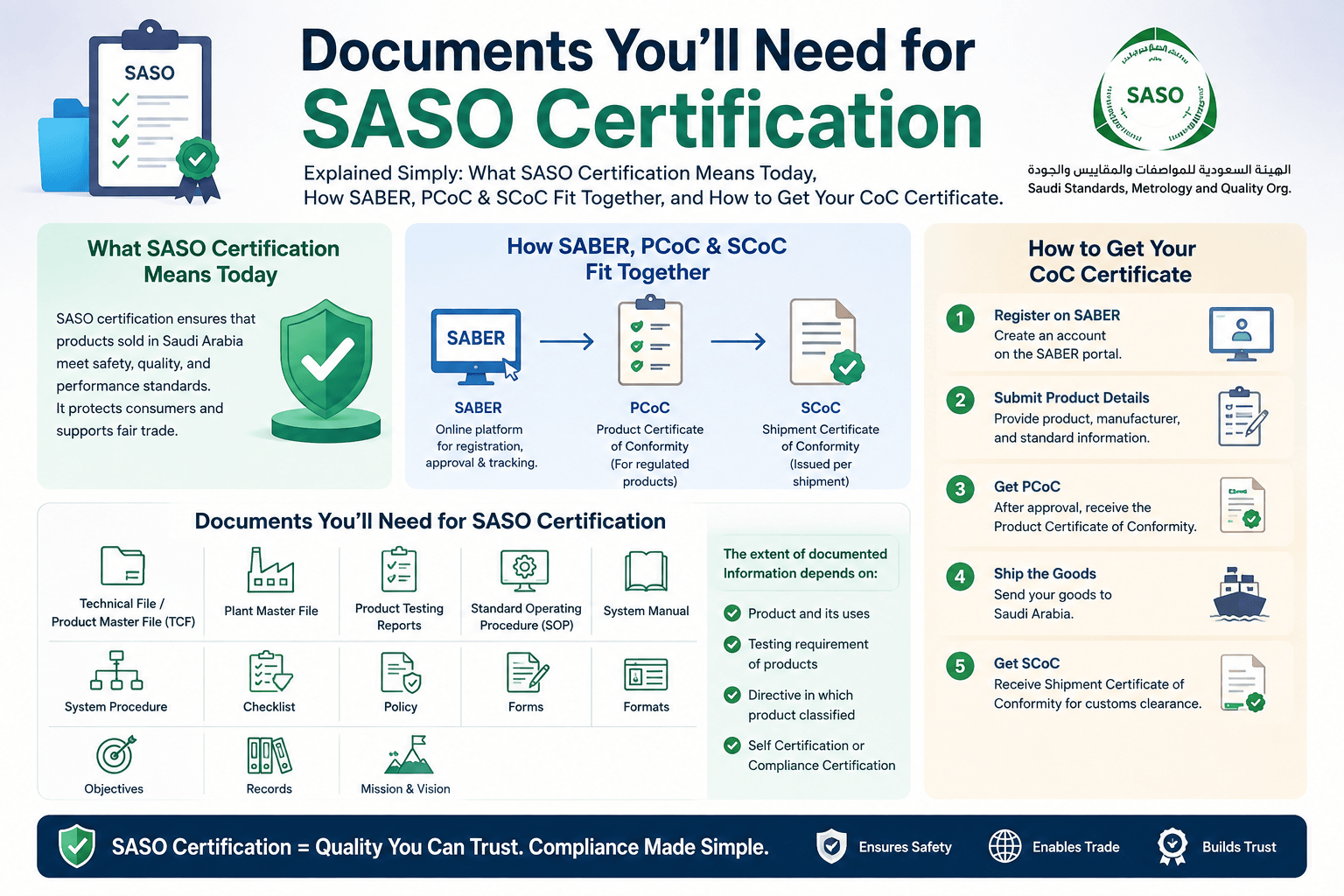
Most people who search for "certification SASO" have already lost time. A...

Most exporters believe global expansion fails because markets are difficult to enter.That’s...
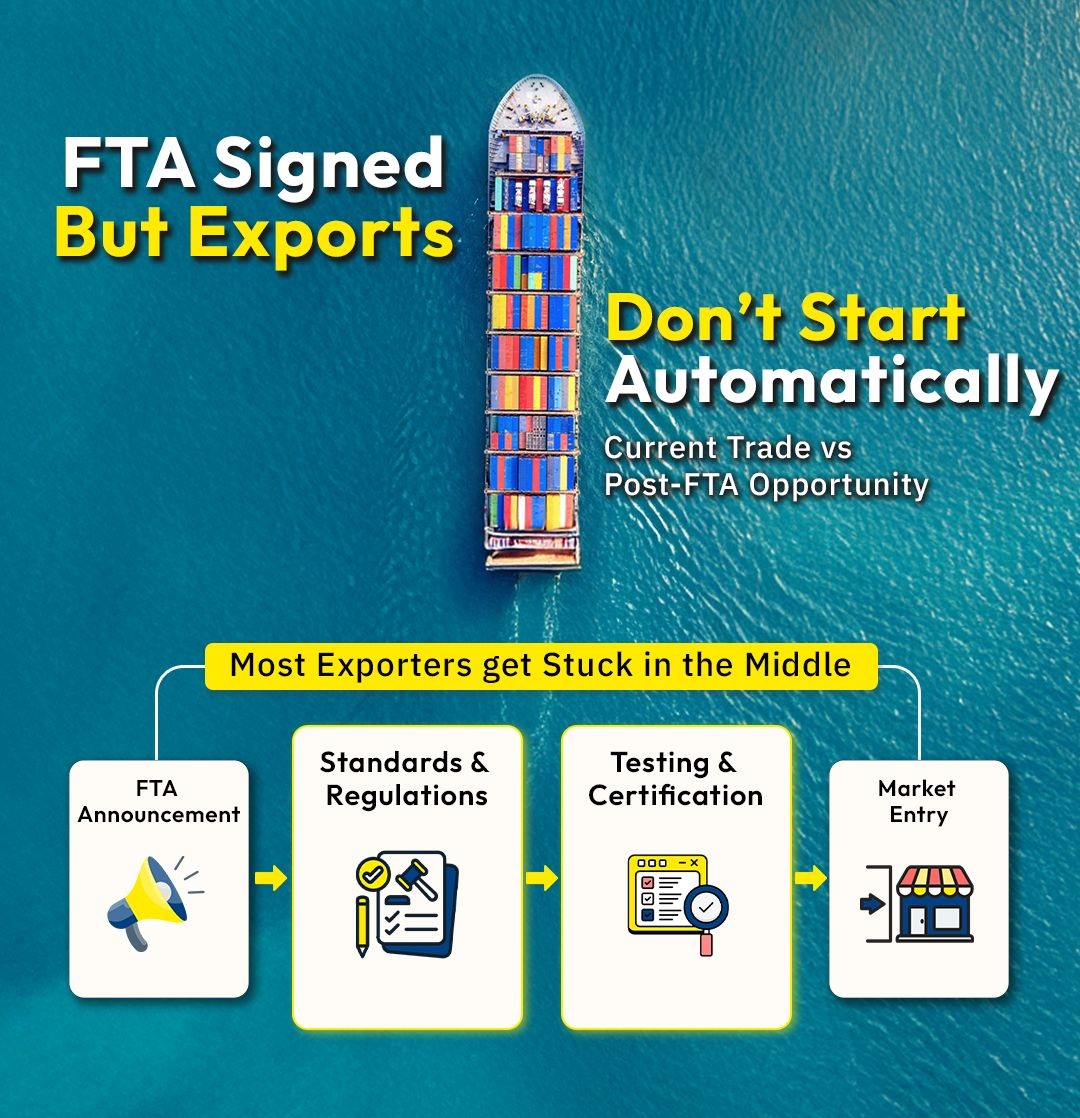
In today’s rapidly evolving global trade landscape, new FTA agreements are being...
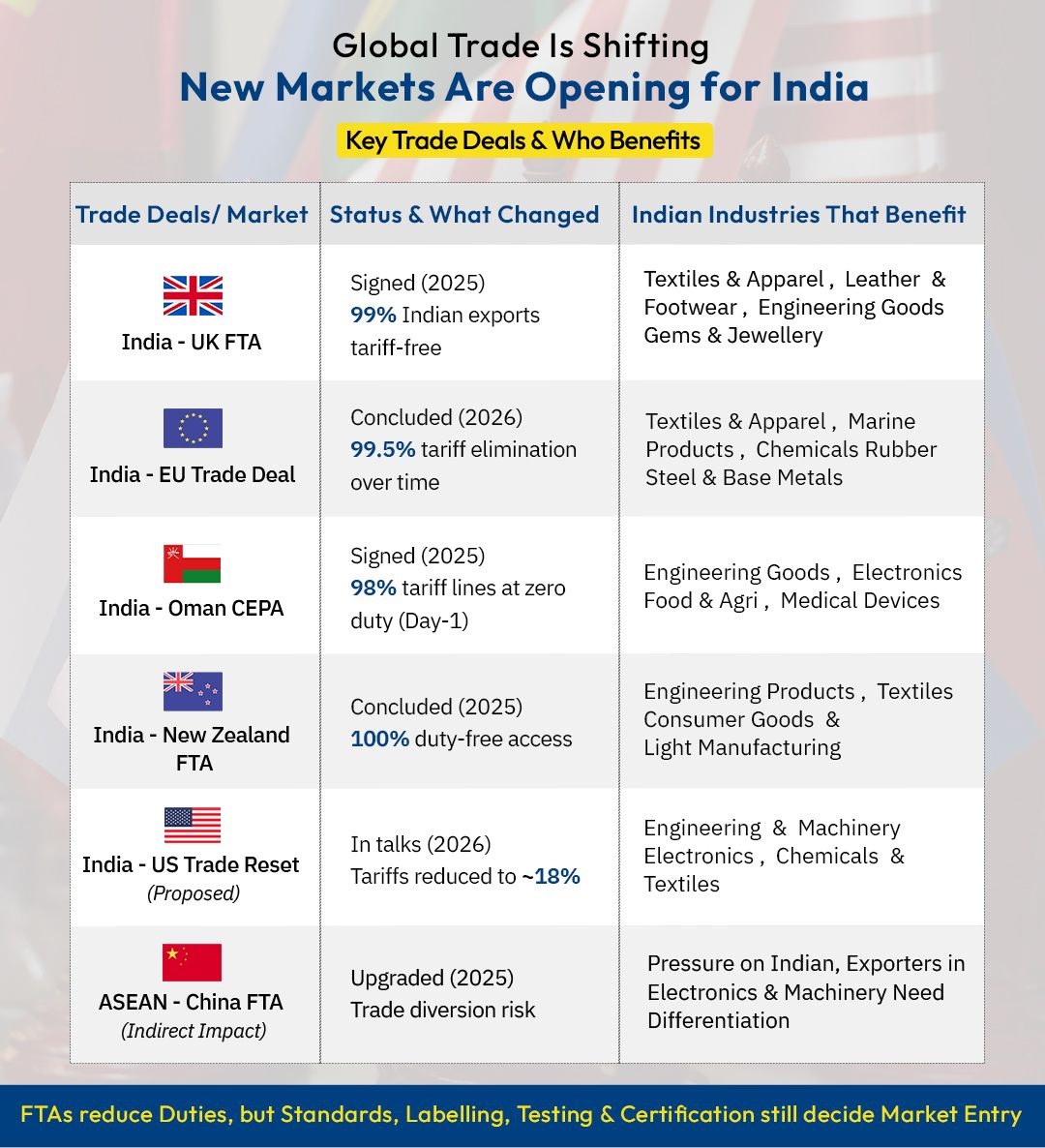
Tariffs Are Falling—But 90% of Indian Exporters Still Can’t Enter Global Market...

Trade policy sounds boring until it shows up in real life. Until...

Introduction A sort of conformity assessment known as CB certification verifies that...

How would you go about requesting an SASO Certificate of Conformity? If...

Overview of the Saber Certificate Companies registered in the Kingdom of Saudi...

Introduction International commerce is vital to the economies of many countries in...

How much does the Saber Certificate cost Recognizing the Saber Certificate Cost...