IS Standard + Overseas Factory Audit
Technical foundation
Global Market Access India BIS FMCS
For foreign manufacturers exporting products to India under a Quality Control Order (QCO) that requires the ISI Mark, a BIS licence through FMCS must be obtained before import, sale or distribution once the order takes effect. Governed by the BIS Act, 2016 and the BIS (Conformity Assessment) Regulations, 2018, the route combines testing against the applicable Indian Standard (IS), a BIS inspection of the overseas factory and its quality-control system, and a licence (CM/L number) to use the ISI Mark. Foreign manufacturers must appoint an Authorized Indian Representative (AIR) for BIS communication and compliance in India.
Technical foundation
Certification outcome
Current mandatory scope
Scope is defined by the Quality Control Orders issued by the relevant ministries and can change as products are added, revised or exempted. Timelines vary by product, factory readiness, audit scheduling and the completeness of the application and test documentation.
At a glance
BIS FMCS Certification is the Scheme I licence route for manufacturers located outside India whose products require the ISI Mark. Where an applicable Quality Control Order (QCO) makes that mark mandatory, the foreign manufacturer must obtain the BIS licence before supplying the product to India.
The licence allows the manufacturer to use the ISI Mark on products covered by its approved scope.
BIS checks conformity with the applicable Indian Standard (IS) and assesses whether the overseas factory has the required manufacturing, testing and quality-control facilities.
The foreign manufacturer applies for the licence and appoints an Authorised Indian Representative (AIR) in India to support communication and compliance with BIS.
Overview
FMCS stands for the Foreign Manufacturers Certification Scheme of the Bureau of Indian Standards (BIS). BIS has operated the scheme since 2000 for manufacturers with factories outside India. An eligible manufacturer can obtain a BIS licence to use the Standard Mark on products that meet the applicable Indian Standard (IS). For products certified under Scheme I, this mark is commonly known as the ISI Mark.
BIS also inspects the overseas manufacturing facility to assess whether it can consistently produce products that meet the applicable Indian Standard. The factory assessment can cover:
A BIS officer visits the factory, and the licence is considered after satisfactory inspection and product test results.
The Foreign Manufacturers Certification Department (FMCD) of BIS handles FMCS applications. The foreign manufacturer applies for and holds the licence for the approved product and manufacturing location.
An Indian importer or distributor cannot be granted the FMCS licence in place of the manufacturer. The scheme helps ensure that products manufactured outside India meet the applicable Indian Standards and conformity requirements for the Indian market.
Applicability
FMCS is required when a foreign manufacturer supplies a product subject to mandatory BIS certification and FMCS is the applicable licensing route.
The requirement depends on the exact product and the Indian rules that cover it. Confirm these five points before testing or filing an application:
Where an effective QCO makes BIS certification mandatory, the covered product needs the required BIS licence before it can be imported or sold in India. For a foreign manufacturer on the Scheme I route, that licence is obtained through FMCS.
For some products, BIS certification may also be available voluntarily where the scheme permits it.
Who Needs It
BIS FMCS applies to manufacturers located outside India whose products fall under applicable BIS certification requirements for the Indian market.
Applicant & licence holder
The foreign manufacturer. Indian importers, distributors and brand owners may support the process, but they cannot obtain the FMCS licence in place of the manufacturer.
The foreign manufacturer must appoint an Authorised Indian Representative (AIR) in India for BIS-related compliance and communication.
A separate application is generally required for each product / Indian Standard and each manufacturing location.
Products & Scope
A product manufactured outside India may require BIS FMCS Certification when its category is subject to mandatory BIS certification and FMCS is the applicable route.
For compulsory products, the concerned Government Ministry or Department issues a Quality Control Order (QCO) specifying the product, its applicable Indian Standard (IS) and the implementation date. Once the QCO takes effect, covered products must meet that standard and carry the required BIS Standard Mark under a valid licence before import, sale or distribution in India.
For a foreign manufacturer, FMCS is generally relevant when the product follows the applicable BIS Scheme I certification route and the manufacturing facility is located outside India.
Not sure whether your product is covered? Share its catalogue, technical specifications and factory location with Markek for an applicability review.
Process
FMCS is more than a document review. Under the Scheme I normal procedure, BIS assesses whether an overseas manufacturer can consistently make a product that meets the applicable Indian Standard. The process generally follows these nine steps:
Review the product’s specifications, construction and intended use against the applicable Indian Standard (IS) and Quality Control Order (QCO). Confirm:
Getting the standard and product scope right matters because the application, factory inspection and product testing are based on them.
Decide which products, grades, sizes, models or varieties the licence should cover. Link that scope to the correct factory and Indian Standard. BIS requires separate applications for different factory locations and product/standard combinations.
Check readiness against the Indian Standard, relevant Product Manual and Scheme of Inspection and Testing (SIT). Preparation generally covers:
Address gaps in equipment, testing capability or records before the BIS factory visit.
The foreign manufacturer appoints an Authorised Indian Representative (AIR) based in India for BIS correspondence and compliance. An eligible person at its Indian branch or office may serve, or it may appoint another eligible India-based person. The foreign manufacturer remains the licence holder, and the AIR’s name is endorsed on the licence.
Submit the product, factory, manufacturing, testing, technical and AIR documents through the applicable Manakonline process. BIS checks the application and may raise queries if information is incomplete or needs clarification. Resolve those queries before the assessment progresses.
A BIS officer visits the overseas facility to verify the manufacturing process, machinery, testing capability, calibration, quality controls, records, and compliance with the applicable Indian Standard and SIT. Production and quality personnel should be ready to demonstrate how the factory manufactures and tests the product.
During the factory visit, BIS normally draws samples for testing at a BIS or BIS-recognised laboratory in India against the relevant Indian Standard. Existing IEC or other international reports do not normally replace the required BIS sample testing.
After satisfactory inspection and test results, resolve any observations, accept the licence conditions, and pay the applicable licence and advance marking fees and other outstanding dues before grant. Prepare the prescribed agreement, indemnity bond and performance bank guarantee for the post-grant formalities.
BIS grants the licence for the approved product scope and factory. The manufacturer completes the prescribed agreement and indemnity formalities and furnishes a USD 10,000 performance bank guarantee immediately after grant. The guarantee is financial security, not a certification fee. The manufacturer may then apply the BIS Standard Mark / ISI Mark to covered products and must continue meeting the Indian Standard, SIT, marking, recordkeeping and surveillance requirements.
How Markek helps: Markek supports foreign manufacturers from Indian Standard identification and factory readiness to AIR coordination, BIS inspection preparation, sample testing and ongoing licence compliance.
Documentation
The exact document checklist depends on the product, applicable Indian Standard and manufacturing location. Main documents generally include:
Keep the file consistent. The manufacturer name, factory address and product details should match across the application, test reports and all supporting documents.
Cost
There is no single fixed cost for FMCS certification. The total depends on the product, applicable Indian Standard, number of product varieties, testing requirements and location of the foreign factory.
Estimate after reviewing the scope. Testing, inspection and travel costs vary, so the final FMCS cost should be assessed after reviewing the product, Indian Standard, factory location and certification scope.
Timeline
BIS indicative processing period
About 6 months
BIS says FMCS licence grant generally takes about six months from the date it records a complete application with the required documents and information. Preparation before that point is additional time, and the estimate is not a guaranteed completion date.
FMCS includes an overseas factory inspection and product testing in India. Confirming the standard, preparing the factory and completing the application file before submission can help prevent avoidable delays.
Plan your project with Markek. We can share an indicative roadmap after reviewing your product, the applicable Indian Standard and your factory’s readiness.
Source: BIS FMCS grant-of-licence guidance.
Common challenges
Many FMCS delays begin with incomplete product, factory or application preparation.
Not sure whether FMCS applies to your product? Confirm the Indian Standard, Quality Control Order (QCO) and BIS scheme before filing.
Unsure which Indian Standard applies? Review the product specifications, manufacturing process and intended use before defining the certification scope.
Factory not ready for BIS inspection? Check the manufacturing machinery, testing facilities, calibration, process controls and records against the applicable BIS requirements.
Required in-house testing equipment is not available? Review the BIS Product Manual and Scheme of Inspection and Testing (SIT) early so the required testing capability can be arranged before inspection.
Can an IEC or international test report replace BIS testing? Do not assume international reports will be accepted. Product conformity must be established against the applicable Indian Standard through the BIS-authorised testing process.
Can the importer apply instead of the manufacturer? No. The FMCS application must be made by the foreign manufacturer.
Foreign manufacturer without an AIR? Nominate an eligible Authorised Indian Representative (AIR) and complete the required documentation before the application progresses.
Product failed independent BIS testing? Identify the non-conforming requirement, take corrective action and complete additional testing where required.
What if sample shipment is delaying the application? Plan the transport of BIS-drawn samples to a BIS-recognised laboratory in India before the factory inspection.
Multiple products or factories need certification? Plan separate applications where required for each product or Indian Standard and manufacturing location.
Review readiness before filing. A factory-readiness and documentation review can prevent many of these issues.
Markek support
Markek helps foreign manufacturers manage the FMCS certification process from initial applicability assessment through factory preparation, BIS inspection, testing and licence coordination.
Our focus: Prepare the product, factory and documentation correctly before BIS assessment so avoidable gaps do not delay the certification process.
Why Markek
An FMCS project requires compliance across borders. It connects foreign manufacturing facilities, Indian regulatory requirements, AIR coordination, BIS inspection, product testing and continuous licence compliance. Markek brings these activities into one clear certification roadmap.
We aim to make the FMCS process clearer for the manufacturer, better prepared before BIS assessment and easier to coordinate across countries.
FMCS is the Foreign Manufacturers Certification Scheme through which manufacturers with factories outside India can obtain an applicable BIS licence for products conforming to Indian Standards.
No. FMCS becomes necessary where the foreign manufacturer’s product requires BIS certification and FMCS is the applicable certification route.
No. The foreign manufacturer must apply for the BIS licence. The importer or Indian partner may assist with coordination but cannot replace the manufacturer as the applicant.
Yes. A foreign manufacturer must nominate an eligible Authorised Indian Representative (AIR) in India.
Yes. BIS visits the overseas manufacturing facility to assess its manufacturing infrastructure, process controls, quality-control arrangements and testing capabilities.
International certification does not automatically replace the BIS testing requirement. BIS requires conformity to the applicable Indian Standard, and samples drawn during the FMCS inspection are tested through the applicable BIS / BIS-recognised laboratory route.
Samples drawn by BIS during the FMCS inspection are required to be tested in BIS laboratories or BIS-recognised laboratories, and BIS guidance states that the applicant sends the drawn samples to the applicable laboratory in India.
No. Separate applications are generally required for each product / Indian Standard.
No. A separate application is required for each manufacturing location.
Not necessarily. BIS states that the licence application is for a product at a manufacturing premises; applicable brand undertakings and supporting documents need to be provided.
BIS indicates an average period of around six months from the recording of a complete application, although inspection scheduling, sample transportation, testing, queries and applicant readiness can affect the actual timeline.
Yes. Under the current FMCS requirements, an applicable Performance Bank Guarantee of USD 10,000 is required as part of the licence requirements.
The licence is initially granted for not less than one year and up to two years. Renewal may be considered for a further period of one to five years, subject to applicable BIS requirements.
MeitY-notified Electronics and IT products generally follow the BIS Compulsory Registration Scheme (CRS) rather than FMCS.
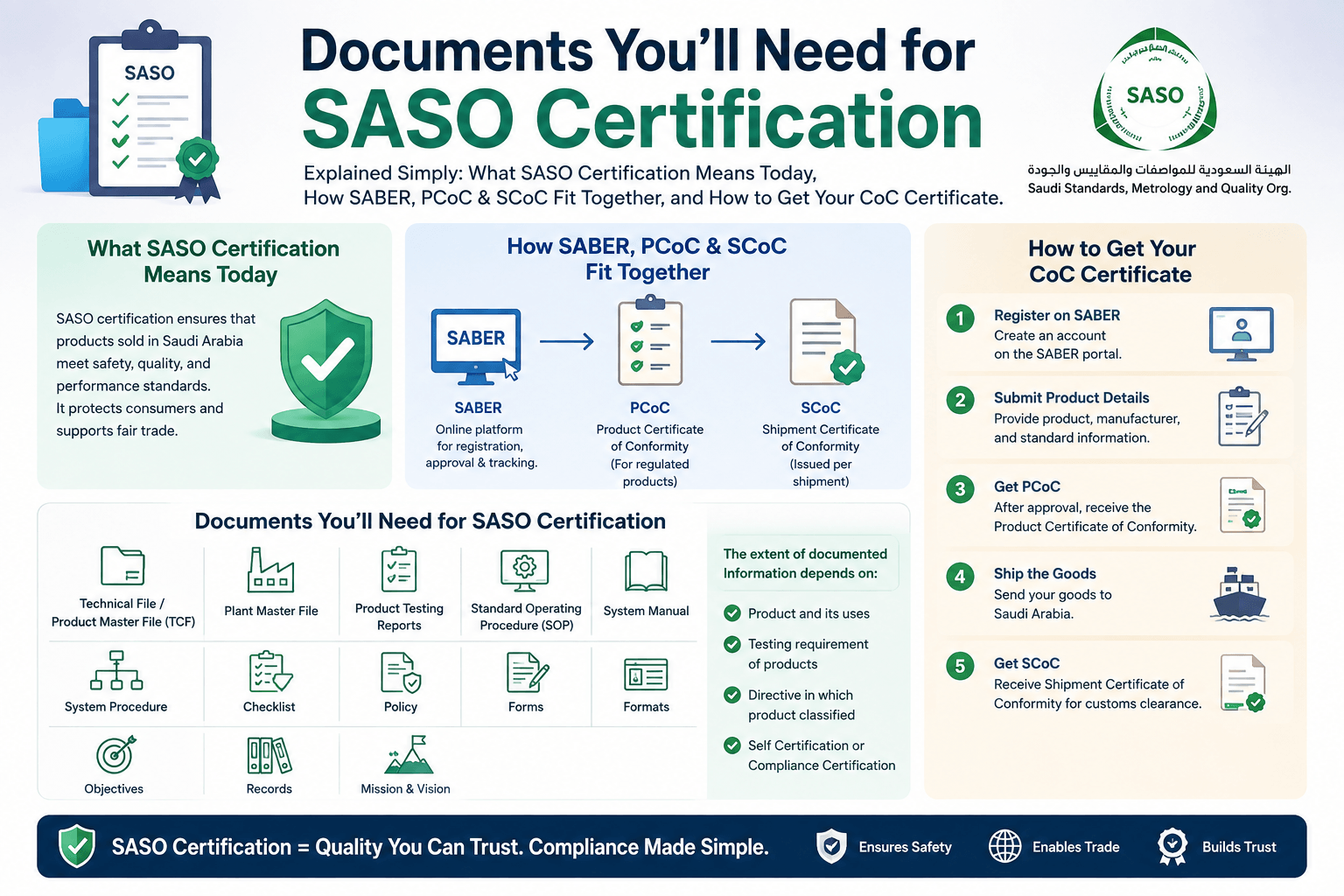
Most people who search for "certification SASO" have already lost time. A...

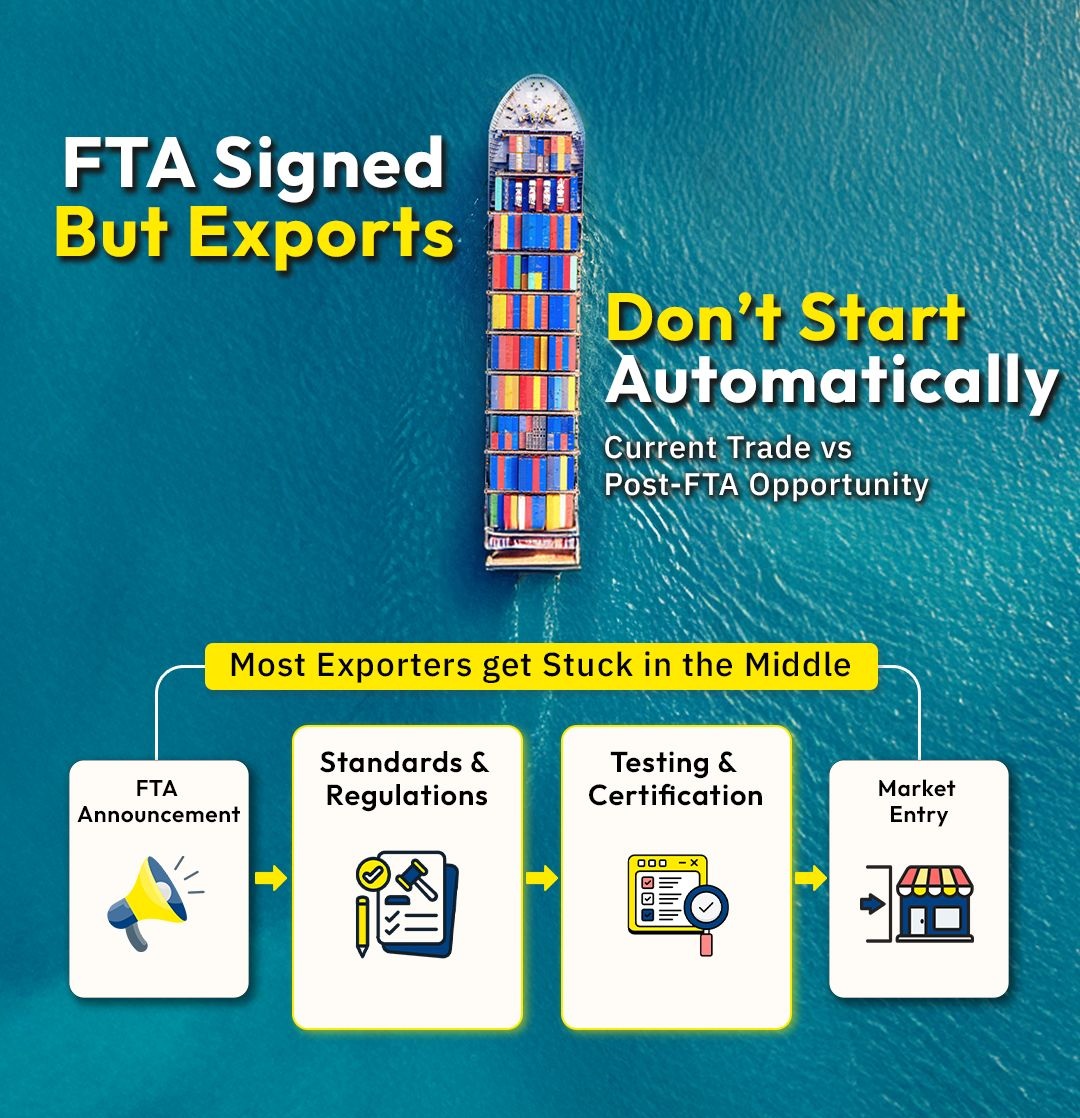
Most exporters believe global expansion fails because markets are difficult to enter.That’s...
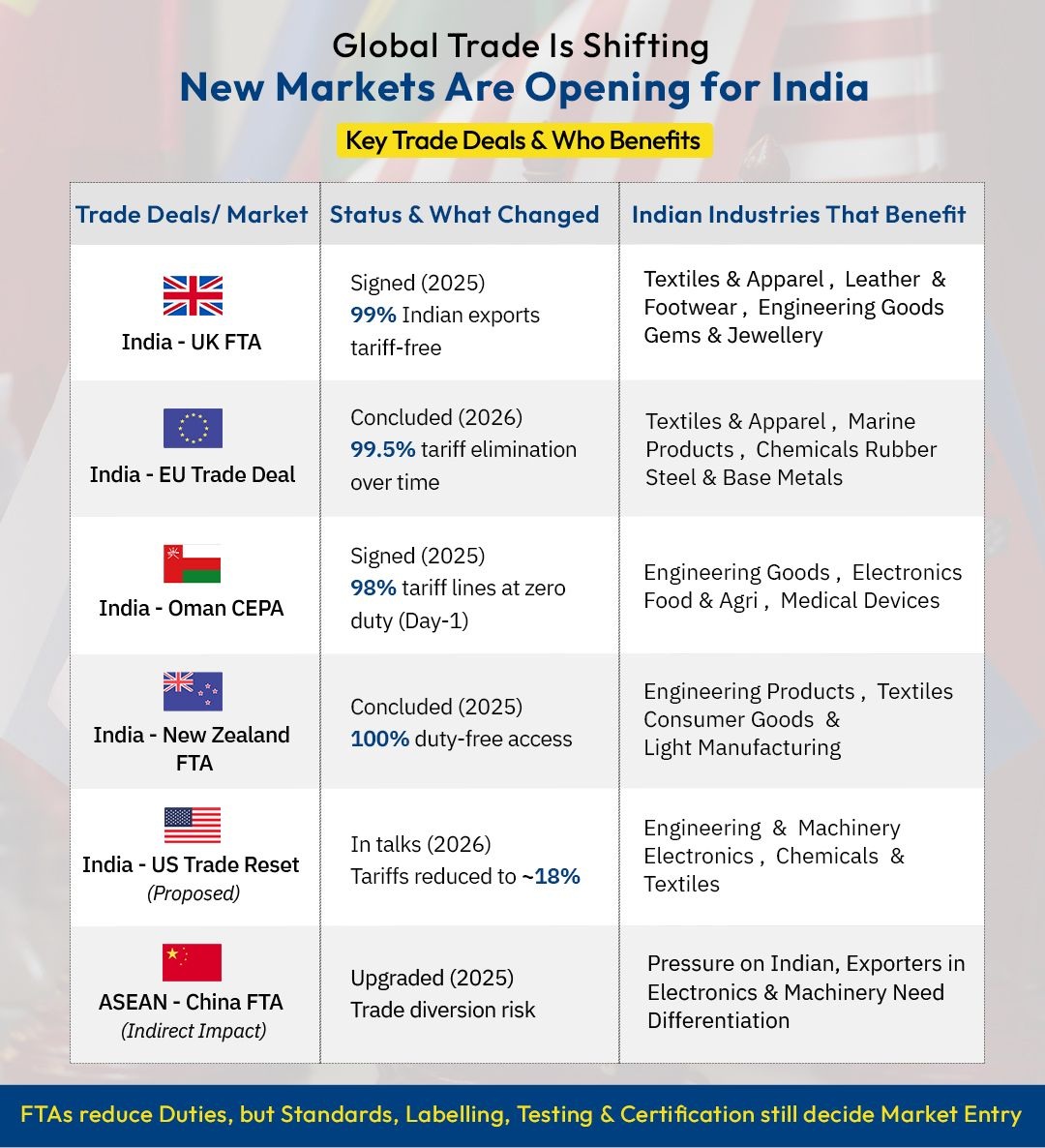
In today’s rapidly evolving global trade landscape, new FTA agreements are being...
Tariffs Are Falling—But 90% of Indian Exporters Still Can’t Enter Global Market...
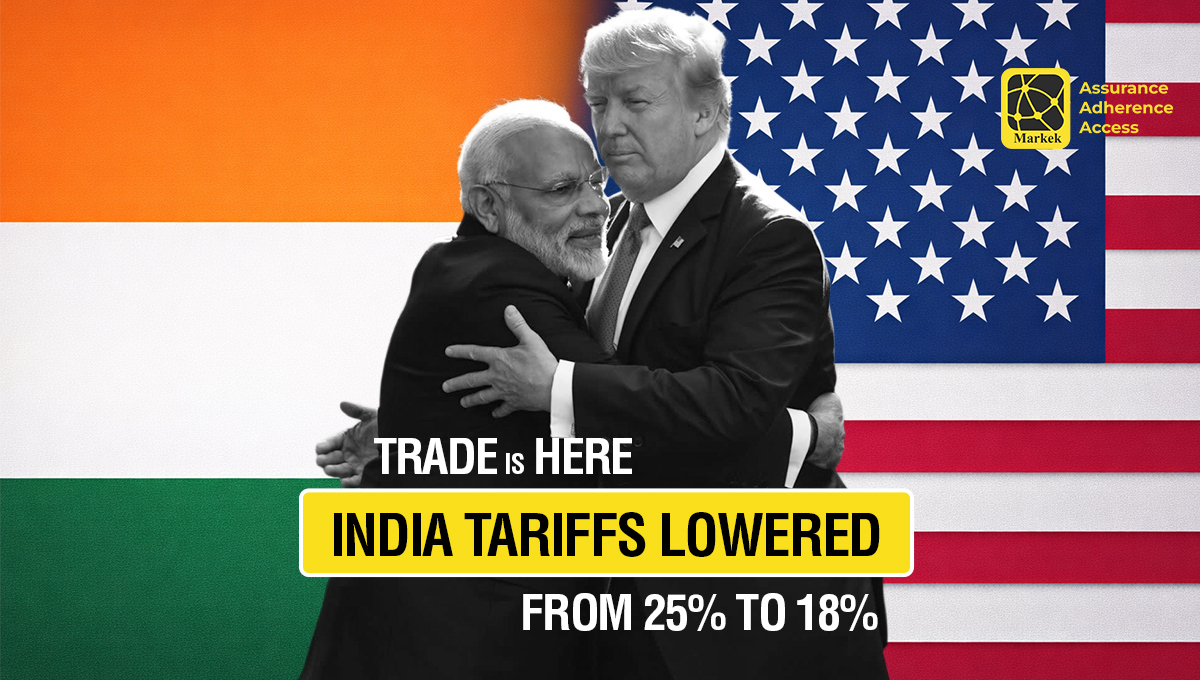
Trade policy sounds boring until it shows up in real life. Until...

Introduction A sort of conformity assessment known as CB certification verifies that...

How would you go about requesting an SASO Certificate of Conformity? If...

Overview of the Saber Certificate Companies registered in the Kingdom of Saudi...

Introduction International commerce is vital to the economies of many countries in...

How much does the Saber Certificate cost Recognizing the Saber Certificate Cost...