The product
Does it comply with the applicable Saudi standard or technical regulation?
Saudi Arabia · Saudi Quality Mark
The Saudi Quality Mark (SQM) is SASO’s license for products manufactured under a controlled and consistently compliant production system. It combines product conformity, testing, quality-system assessment, and a factory audit. SQM is mandatory for specific product categories and available voluntarily for other eligible products where the relevant Saudi standard and granting procedure exist.
At a Glance
The term “SQM Certification” is commonly used to refer to the license for using the Saudi Quality Mark. SASO grants the mark when the product meets the applicable Saudi requirements and the manufacturer demonstrates an effective management and production-control system capable of maintaining that conformity. The process typically involves technical-document review, product testing, a factory audit, and ongoing surveillance.
On this page, you’ll understand the following:
Overview
The SQM is owned by SASO. It is placed on products that have been granted a license to use the mark.
SQM does more than check a single sample. It looks at both:
Does it comply with the applicable Saudi standard or technical regulation?
Can the manufacturer continue producing the same compliant product consistently?
That is why SQM typically involves:
Once granted, the license allows the approved product to carry the Saudi Quality Mark.
Who Needs It
Manufacturers whose products fall under the mandatory SQM categories
Foreign manufacturers exporting these products to Saudi Arabia
Saudi manufacturers and suppliers seeking an SQM license
Manufacturers pursuing SQM voluntarily for an eligible product
Companies whose Saudi conformity route requires SQM alongside other product-specific approval
Mandatory Products
SASO currently identifies 10 product categories for which the Saudi Quality Mark is mandatory, which are as follows:
| Mandatory Product Category | Typical Area |
|---|---|
| Gas-operated appliances and accessories | Gas appliance safety |
| Reinforcement steel bars | Construction |
| Cement | Construction |
| Ready-mixed concrete | Construction |
| Ceramic and porcelain tiles | Building products |
| Iron sheets / flat steel products | Construction |
| Aluminum composite cladding panels | Building facades |
| Plastic degradation aids | Environmental/plastics |
| Electrical connections | Electrical products |
| Plugs & electrical switches | Electrical products |
For products outside the mandatory list, SQM may still be available voluntarily where the relevant Saudi standard or granting procedure exists.
That is why the complete regulatory route should be mapped before the SQM application starts.
Which Route Applies?
These three terms often appear together, but they perform different jobs.
| Comparison | SQM | SABER | G-Mark |
|---|---|---|---|
| What is it | Saudi national quality-mark license | Saudi product and shipment conformity platform | Gulf conformity route |
| Framework | SASO | SASO | GSO |
| Main purpose | Product conformity + consistent manufacturing controls | Identifies and manages Saudi conformity requirements | Conformity under specific Gulf Technical Regulations |
| Factory audit | Core part of the SQM process | Not a function of the platform itself | Depends on the applicable Gulf route |
| Scope | Mandatory categories + eligible voluntary products | Products entering the Saudi conformity system | Products covered by applicable Gulf regulations |
It is the license to use the Saudi Quality Mark. It assesses the product and the manufacturing system behind it.
It is the Saudi electronic conformity platform. It is used to manage applicable product and shipment conformity requirements; SABER itself is not a certification scheme.
It applies to products covered by specific Gulf Technical Regulations, such as certain low-voltage electrical equipment and toys.
So the correct question is not simply, “Do I need SQM or G-Mark?” It is:
Which Saudi and Gulf conformity requirements apply to this exact product and HS code?
Process
Determine whether SQM is mandatory or voluntary and identify the applicable Saudi standard, technical regulation, and granting procedure.
Register the establishment, complete the SQM application, and compile the required company and product information.
Provide an ISO/IEC 17025-accredited laboratory report covering the product and applicable standard. Additional testing may be needed where evidence is incomplete.
Prepare the Quality Manual or QMS, production-control procedures, self-monitoring records, and quality-control scheme.
Officials assess the factory/production site to verify manufacturing controls and its continued ability to produce compliant products. Samples may also be taken for testing.
Once technical, testing, and audit requirements are satisfied, the application moves through review and decision-making before the license to use the SQM is issued.
DOCUMENTATION
SASO’s current licensing requirements include documentation covering both the establishment and the product.
Depending on the product, SASO may also require:
TIMELINE & VALIDITY
SASO’s current Quality Mark Licensing Service document lists a service-completion period of 70 business days. This should be treated as the authority’s service timeframe, not a guaranteed end-to-end project duration. Testing, document preparation, audit scheduling, and corrective actions can extend the total project.
The Saudi Quality Mark license is valid for three years.
Approval does not end the compliance process. SASO requires regular follow-up visits at least once annually during the license period.
So, the manufacturer should maintain periodic records of product testing and inform the certification body about the relevant changes to the products or production lines.
COST
SQM cost depends on the product scope and manufacturing site rather than on one fixed figure.
SASO publishes separate charges for these activities, with costs varying by the number of products and type of application.
Share your product and factory details for a route-specific quotation.
COMMON MISTAKES
SABER manages the conformity route; it does not remove a mandatory SQM requirement.
SQM applications may still require G-Mark, IECEE, or efficiency-label evidence.
The manufacturing system and factory audit are central to approval.
Procedures must be supported by actual implementation and records at the factory.
The test report must come from an appropriately accredited laboratory covering the relevant product field.
Models, labeling, specifications, test reports, and production information need to remain aligned.
Relevant changes should be communicated during the license period.
Follow-up audits and continued product testing are part of maintaining the three-year license.
MARKEK SUPPORT
Markek helps manufacturers and exporters navigate the complete Saudi Quality Mark process.
We confirm whether SQM is mandatory or voluntary and map any SABER, G-Mark, IECEE, or efficiency requirements alongside it.
We review existing test evidence and prepare the product documentation required for the application.
We assess factory procedures, production controls, records, and audit readiness before the formal assessment.
We support the application, technical review, testing, audit coordination, and corrective-action process.
After approval, we help manufacturers stay prepared for periodic follow-up and product or production changes.
SQM Certification is the process of obtaining SASO’s license to use the Saudi Quality Mark. It combines product conformity with assessment of the manufacturer’s management and production-control system.
SASO currently lists 10 mandatory categories, including cement, ready-mixed concrete, reinforcement steel, ceramic tiles, gas appliances, electrical connections, plugs and switches, and specified building and plastic products.
No. SQM is mandatory only for specified categories. For other products, it can be voluntary where an applicable Saudi standard or granting procedure exists.
SQM is a product quality-mark license involving product and factory assessment. SABER is the Saudi electronic platform used to manage applicable product and shipment conformity requirements.
SQM is a Saudi national quality mark. G-Mark is a Gulf conformity route under specific GSO technical regulations. A product can require both where the applicable regulations say so.
Yes. SASO’s SQM requirements specifically ask applicants to provide G-Mark evidence where the product is also subject to the Gulf Conformity Mark.
The audit checks whether the production system can consistently manufacture products that meet the applicable requirements. Auditors review processes, quality controls, records, and product conformity and may withdraw samples for testing.
SASO currently lists 70 business days as the Quality Mark licensing service duration. The overall project may take longer if testing, preparation, audit scheduling, or corrective actions are needed.
The license is valid for three years, with regular follow-up visits at least annually and renewal requirements before or around the end of the license cycle.
Typical documents include company and manufacturing licenses, QMS documentation, quality-control procedures, product information, laboratory test reports, trademark documents, barcodes, and additional approvals such as G-Mark or IECEE, where applicable.
SASO lists free issuance of product and shipment conformity certificates in SABER among the benefits of obtaining the Saudi Quality Mark.
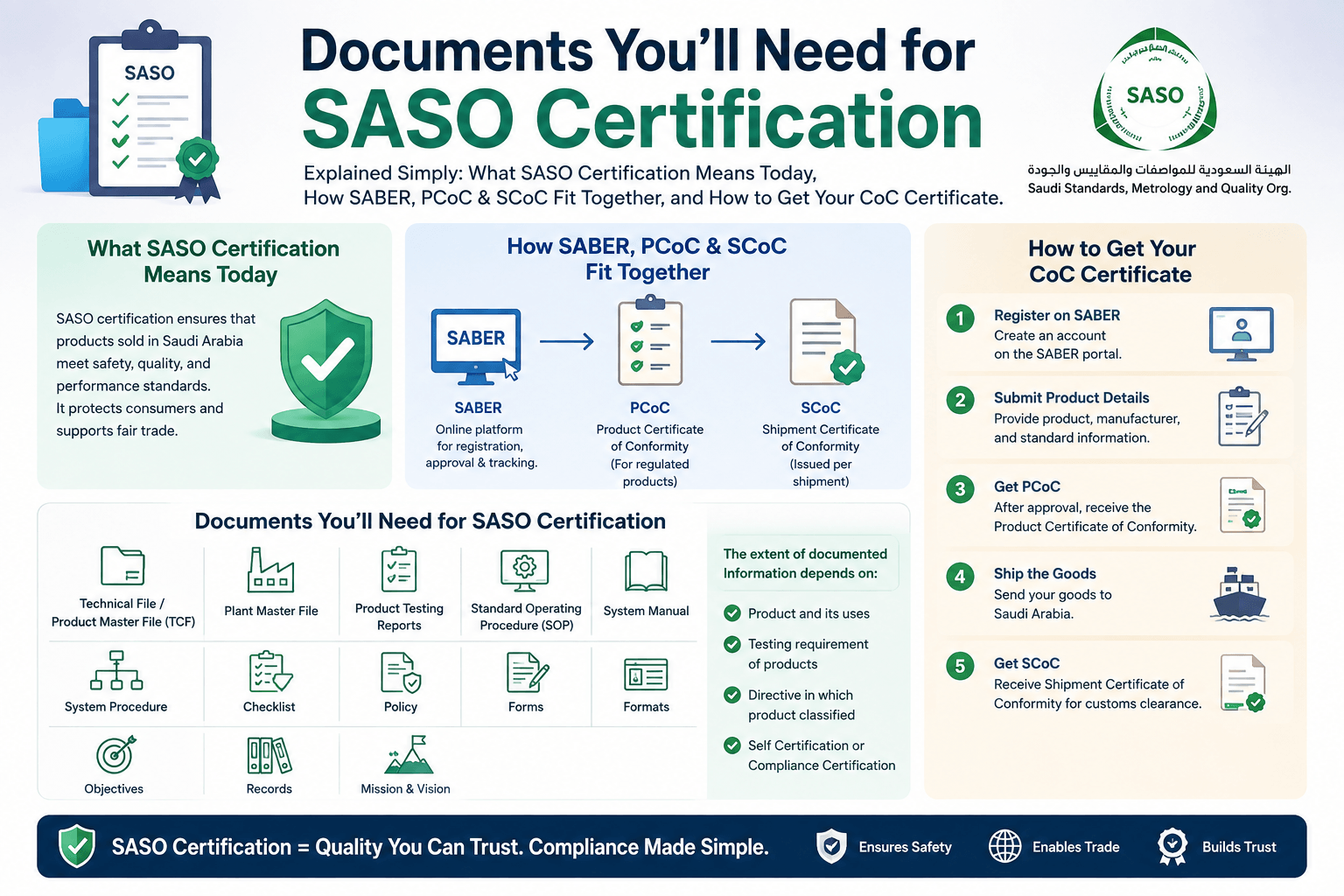
Most people who search for "certification SASO" have already lost time. A...

Most exporters believe global expansion fails because markets are difficult to enter.That’s...
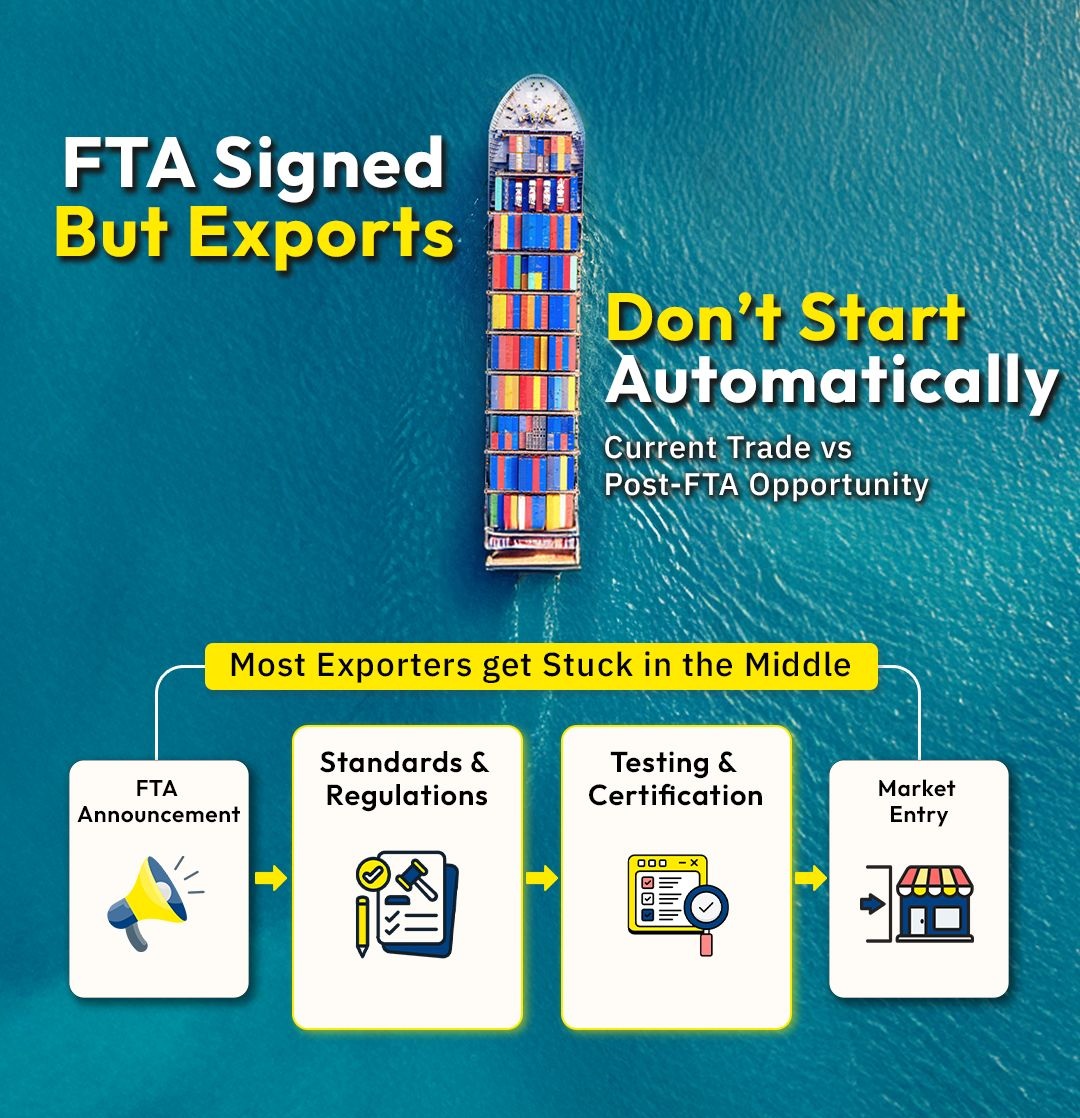
In today’s rapidly evolving global trade landscape, new FTA agreements are being...
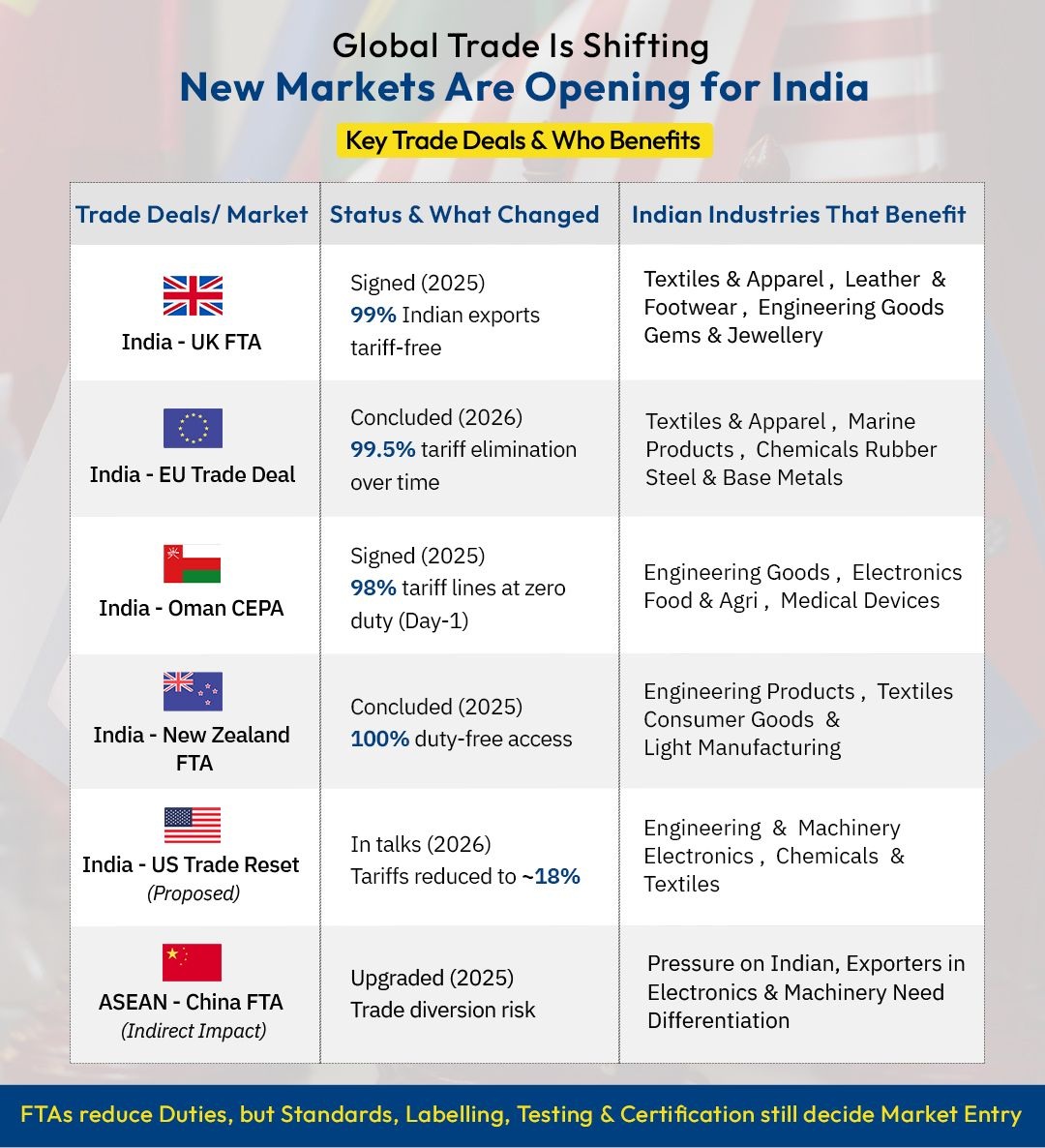
Tariffs Are Falling—But 90% of Indian Exporters Still Can’t Enter Global Market...
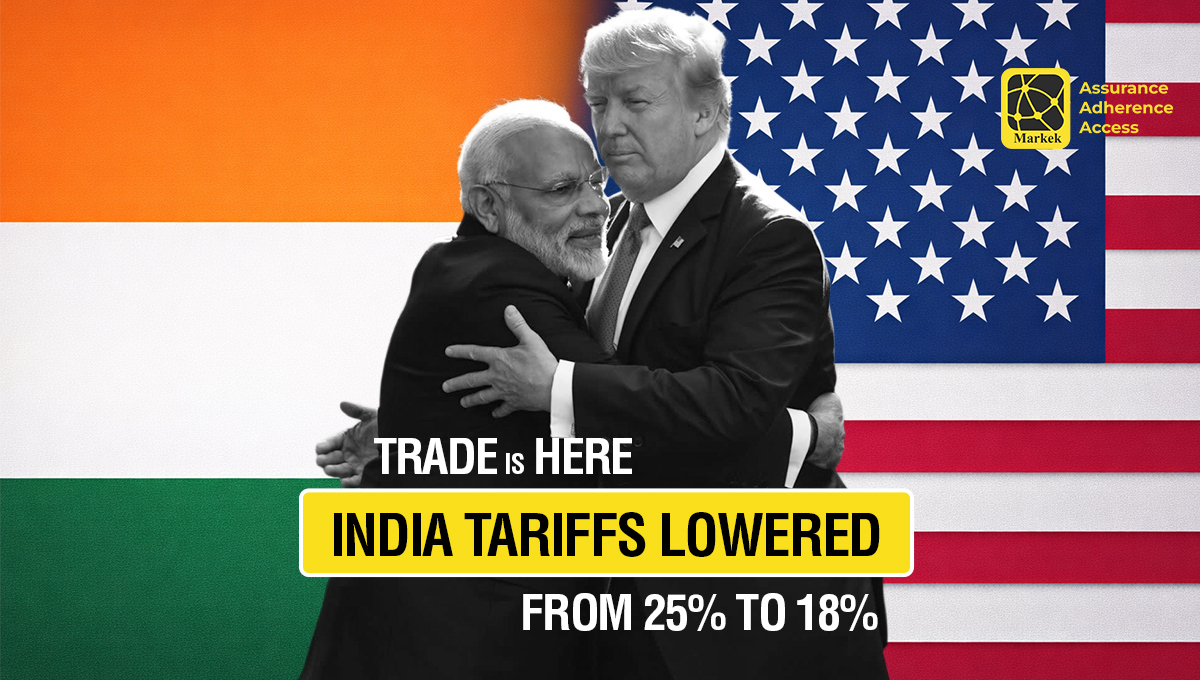
Trade policy sounds boring until it shows up in real life. Until...

Introduction A sort of conformity assessment known as CB certification verifies that...

How would you go about requesting an SASO Certificate of Conformity? If...
Overview of the Saber Certificate Companies registered in the Kingdom of Saudi...

Introduction International commerce is vital to the economies of many countries in...

How much does the Saber Certificate cost Recognizing the Saber Certificate Cost...