Essential Requirements Testing + TEC-Designated Lab
Technical foundation
Global Market Access India TEC MTCTE
For telecom equipment notified under the MTCTE regime, manufacturers and importers must obtain certification before sale, import or deployment in India. The route is based on testing against the applicable Essential Requirements (ERs), normally through a TEC-designated Indian laboratory, followed by certification issued by the Telecommunication Engineering Centre (TEC) under the Department of Telecommunications. TEC may accept specified alternative test reports where a current circular permits them. Foreign manufacturers must appoint an Authorized Indian Representative (AIR).
Technical foundation
Certification outcome
Current mandatory scope
Scope follows current DoT/TEC phase-wise notifications and may change as equipment categories are added or revised. The testing route and timeline depend on the product, laboratory scheduling, and the completeness of the test report and application.
At a Glance
TEC MTCTE Certification is mandatory for notified telecom and related information and communication technology (ICT) equipment before it can be sold, deployed, or used in India. MTCTE stands for Mandatory Testing and Certification of Telecommunication Equipment. Certification is issued by the Telecommunication Engineering Centre (TEC), the technical wing of India’s Department of Telecommunications (DoT).
Equipment covered by MTCTE must be assessed against the applicable Essential Requirements (ERs) and complete the TEC certification process. Routers, switches, network equipment, and transmission equipment are examples of products that may fall within a notified category; the exact product and its technical features determine the route.
Overview
The Telecommunication Engineering Centre (TEC) is the technical organisation under India’s Department of Telecommunications (DoT) responsible for telecom standards, testing and certification. Under the Mandatory Testing and Certification of Telecommunication Equipment (MTCTE) framework, notified telecom and related ICT equipment must meet the applicable requirements before it can be sold, deployed or used in India.
The applicable product ER sets the assessment criteria. Depending on the equipment and current DoT notifications, these can include:
The relevant ER depends on the product’s type, function, interfaces and configuration. MTCTE checks that equipment meets the required standards and helps protect telecom networks, users and other connected equipment.
Mandatory scope
Yes, for telecom equipment notified under MTCTE once its mandatory certification date is in force. Not every electronic, wireless or communication product automatically requires MTCTE certification.
Who needs it
TEC MTCTE certification applies to telecom equipment within an active notified category. The applicant route depends mainly on whether the product belongs to an Indian OEM or brand owner or a foreign OEM.
An Indian OEM or Indian brand owner registers its own company profile on the MTCTE portal and applies for its products. It provides business details, an authorised user, and the required product and technical documents. TEC’s instructions say the Indian company performs its own certification activities rather than appointing another company to apply on its behalf.
A foreign OEM appoints an Authorised Indian Representative (AIR), an Indian company or firm authorised to handle MTCTE activities and obligations for that OEM. The AIR’s work can include:
The foreign OEM and AIR must provide the required authorisation and supporting documents. Under TEC’s current portal instructions, the AIR registers its company profile and adds the foreign OEM’s profile before applying for that OEM’s products.
| Product owner / manufacturer | MTCTE applicant |
|---|---|
| Indian OEM | Indian OEM |
| Indian brand owner | Indian brand owner |
| Foreign OEM | Appointed Authorised Indian Representative (AIR) |
| Indian importer of a foreign OEM’s product | May apply if appointed as that foreign OEM’s AIR |
Product scope
MTCTE applies to notified telecom and ICT equipment used in communication, networking, transmission and telecom infrastructure. These are common product groups to review:
Share your product name, model and technical datasheet with Markek for an applicability review.
Certification schemes
GCS and SCS are two routes to MTCTE certification. The main difference is how TEC handles the submitted test reports.
| Scheme | How it works |
|---|---|
| GCSGeneral Certification Scheme | The product undergoes laboratory testing. The applicant submits test-wise compliance and test reports, which TEC evaluates against the applicable Essential Requirements before certification. |
| SCSSimplified Certification Scheme | Testing and submission of test-wise compliance and reports are still required. TEC does not routinely evaluate the submitted reports, although it may request clarification from the applicant. |
Both schemes require compliance with the product’s applicable technical requirements. TEC assigns the scheme by product category, so the current MTCTE product list should be checked before testing or applying.
Security certification
The National Centre for Communication Security (NCCS) handles security testing and certification for notified telecom products. The assessment considers the complete product, including its software, firmware and security controls.
Having software alone does not make NCCS certification mandatory. The requirement depends on the product category and the applicable security notification.
These examples are subject to their notified scope and any current exemptions:
Process
The TEC MTCTE certification process starts with checking the product correctly before testing begins. Defining the right category, scope and route early helps avoid incorrect tests, extra costs and delays.
Confirm whether the product requires TEC MTCTE certification and whether any NCCS security requirement (ITSAR) also applies. Check:
Define the main and associated models, hardware and software versions, interfaces, ports, product configurations and manufacturing location. Correct model grouping helps avoid duplicate testing and applications.
The applicant needs an approved profile on the TEC MTCTE portal. An Indian OEM or brand owner registers its own company. A foreign OEM appoints an Authorised Indian Representative (AIR) to handle MTCTE activities in India.
Identify the tests required for the exact product category, variant and applicable requirements before sending samples.
Review existing reports, accepted testing options and current exemptions before repeating tests. Confirm that the reports match the model, hardware, software and scope in the application.
Submit the product and model details, Bill of Materials (BoM), technical documents, applicable test reports, declarations and government fees through the relevant portal steps. All submitted information should match the tested product and certification scope.
TEC reviews the application and supporting details. Under GCS, TEC evaluates the submitted test reports; under SCS, reports are submitted but are not routinely evaluated by TEC. TEC may still request clarification. Where ITSAR security certification applies, NCCS evaluates the security testing evidence. Respond to any document or technical queries with consistent information.
Once the applicable requirements are met, the certification is issued. If an ITSAR security requirement applies, the product must also complete the required NCCS security evaluation and certification route. Follow the applicable TEC labelling requirements before placing the certified product on the Indian market.
Documentation
The exact documents depend on the product and whether the applicant is an Indian manufacturer or represents a foreign OEM. Common documents may include:
Cost
There is no fixed total cost for TEC MTCTE Certification. The final amount depends on the product, certification scope and testing needed. Under the current MTCTE procedure, the administrative fee is based on the equipment group.
| Equipment group | Administrative fee |
|---|---|
| Group A | ₹10,000 |
| Group B | ₹20,000 |
| Group C | ₹30,000 |
| Group D | ₹50,000 |
Source: TEC MTCTE Procedure v3.0, Annexure C. Confirm the current fee before filing.
Testing is separate. Laboratory charges depend on the product and required test scope.
Family-based certification is charged according to Group D under the current procedure.
Timeline
Certification timing depends on product complexity, testing requirements, laboratory availability and application readiness. Under the current TEC procedure, the normal issuance periods below begin after complete test reports are submitted.
Normal certificate issuance
4–8 weeks
From submission of complete test results or reports, depending on equipment complexity.
Normal certificate issuance
15 working days
From submission of complete test reports.
Source: TEC MTCTE Procedure v3.0, clauses 6.1.4 and 6.2.4. These are normal processing periods, not guaranteed end-to-end project timelines.
Common challenges
A product’s market name may not match the category used by TEC. Selecting the wrong product category or Essential Requirement (ER) can lead to incorrect testing and delays in the MTCTE certification process.
Main models and associated models must be grouped correctly. Wrong grouping can lead to extra testing, separate applications and higher certification costs.
The product datasheet, Bill of Materials (BoM), model details and test reports should match. Differences can result in TEC queries or application corrections.
The product must be tested for the correct ER parameters through the appropriate testing route and laboratory. Missing or incorrect test parameters can delay TEC MTCTE Certification.
Foreign test reports are not automatically accepted for every product or test. Acceptance depends on current TEC rules, the product category and the specific test parameter.
For a foreign manufacturer, the Authorised Indian Representative (AIR) documents must be complete and correctly prepared before the MTCTE application moves forward.
MTCTE may not be the only approval required for a telecom product in India. Depending on the product, separate approvals such as WPC ETA or NCCS security certification may also apply.
Markek support
Markek supports Indian and foreign manufacturers through the TEC MTCTE certification process, from initial product assessment to final certification coordination.
Determine whether MTCTE applies and identify the product category, Essential Requirement (ER), GCS or SCS route and NCCS requirement, where applicable.
Review main and associated models, hardware and software versions, interfaces and product configurations.
Plan the testing scope, coordinate with a designated laboratory, review technical documents and check test reports before submission.
Support foreign manufacturers with OEM profile requirements, Authorised Indian Representative (AIR) documentation and application coordination.
Coordinate MTCTE portal filing, TEC queries, observations and required responses.
Support certification coordination, TEC labelling, modifications and renewals.
Why Markek
TEC MTCTE certification is not only about submitting an application. The product category, ER, model scope, testing requirements and documentation must all match. Markek follows a product-first approach to help manufacturers plan the certification process correctly from the beginning.
We help identify what the product actually requires before testing, reducing the risk of selecting the wrong ER, model scope or certification route.
Our approach considers the product’s models, interfaces, hardware and software configuration, testing requirements and regulatory requirements together.
We support Indian applicants and foreign OEMs that may need AIR, OEM registration, MTCTE and NCCS coordination.
Correct planning before testing can help reduce unnecessary testing, duplicate applications, documentation gaps and avoidable queries.
Markek helps connect product assessment, testing, documentation, application and certification activities through one coordinated process, giving manufacturers a clearer and more manageable route to TEC MTCTE Certification in India.
MTCTE stands for Mandatory Testing and Certification of Telecommunication Equipment
TEC Certification refers to certification administered by the Telecommunication Engineering Centre, Department of Telecommunications. For notified telecom products, MTCTE is the mandatory certification framework.
Yes, for telecom equipment that has been notified under MTCTE and whose mandatory certification date has become effective.
A foreign OEM requires an eligible Authorised Indian Representative (AIR) in India to handle its MTCTE certification obligations.
Essential Requirements or ERs are the technical and regulatory requirements against which a telecom product is tested and assessed.
A regular MTCTE certificate is generally valid for 10 years, subject to the applicable certification conditions.
No. TEC MTCTE and WPC are separate regulatory requirements. A wireless telecom product may require both depending on its technical specifications.
In certain cases, main and associated models can be covered together if they meet the applicable MTCTE model-grouping requirements.
The cost depends on the equipment group, product, number of models, applicable ER and laboratory testing requirements. TEC administrative fees currently range from ₹10,000 to ₹50,000, excluding laboratory and other applicable costs.
After complete test reports are submitted, TEC currently indicates approximately 4–8 weeks for GCS and 15 working days for SCS. Testing and preparation time are additional.
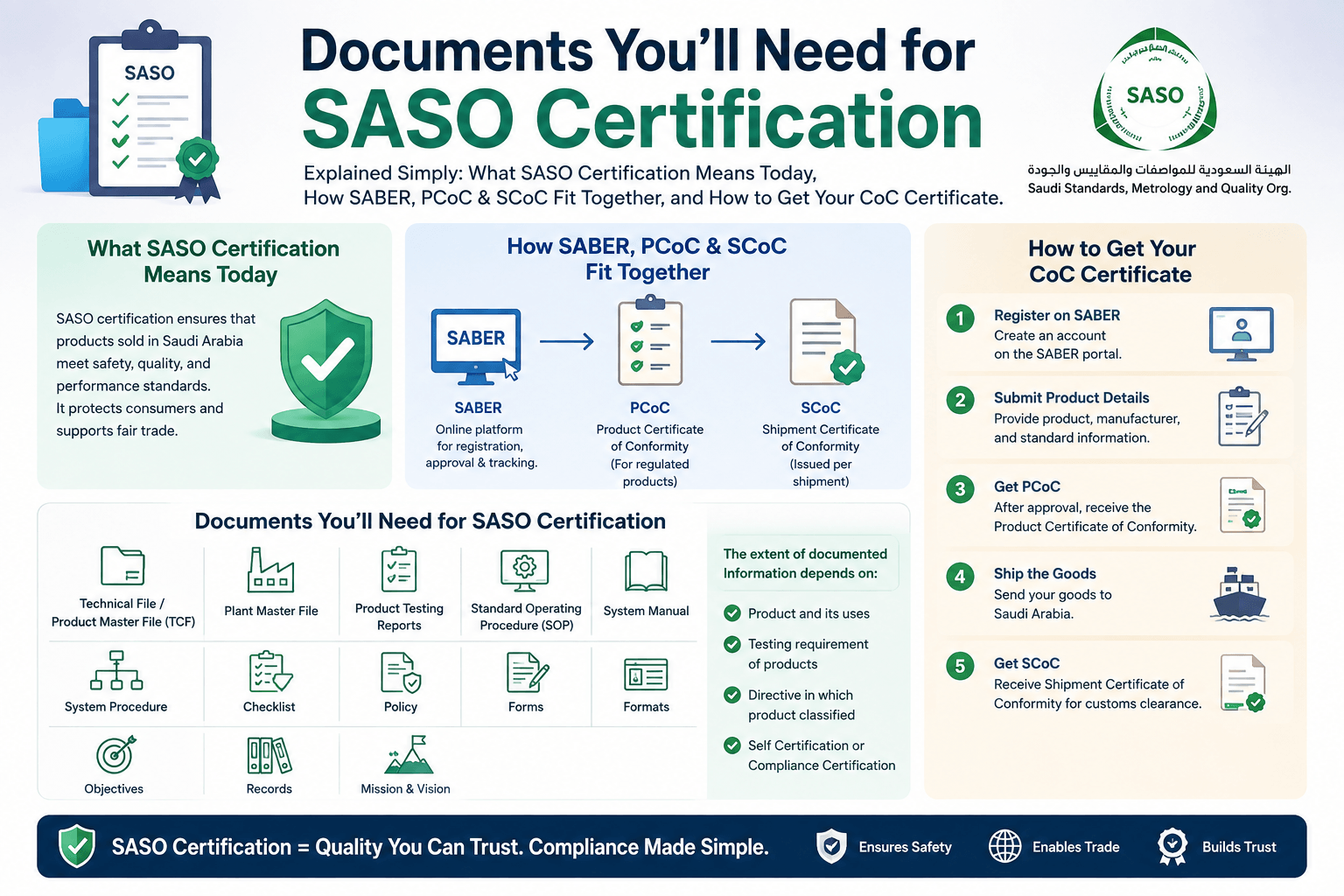
Most people who search for "certification SASO" have already lost time. A...

Most exporters believe global expansion fails because markets are difficult to enter.That’s...
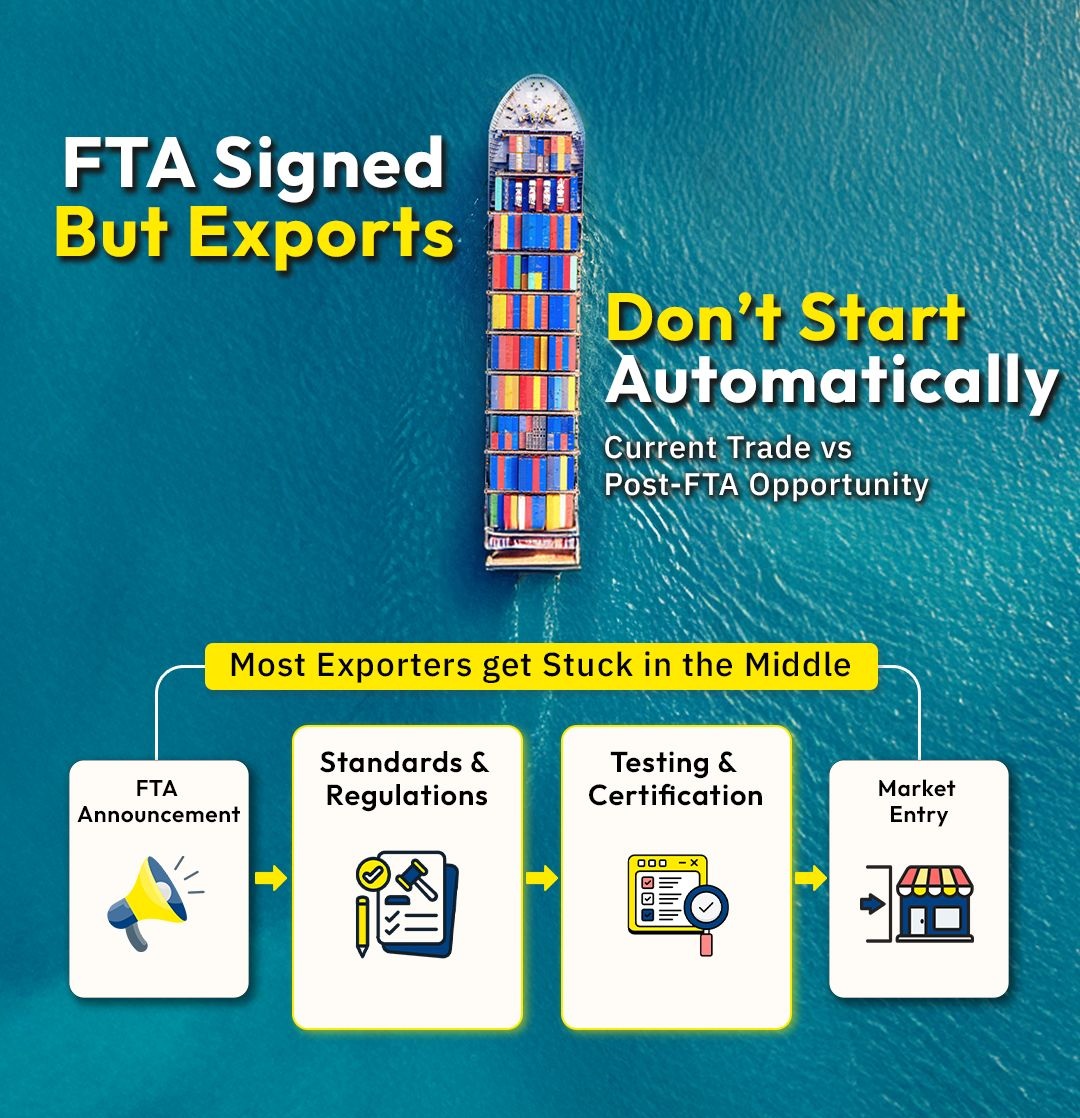
In today’s rapidly evolving global trade landscape, new FTA agreements are being...
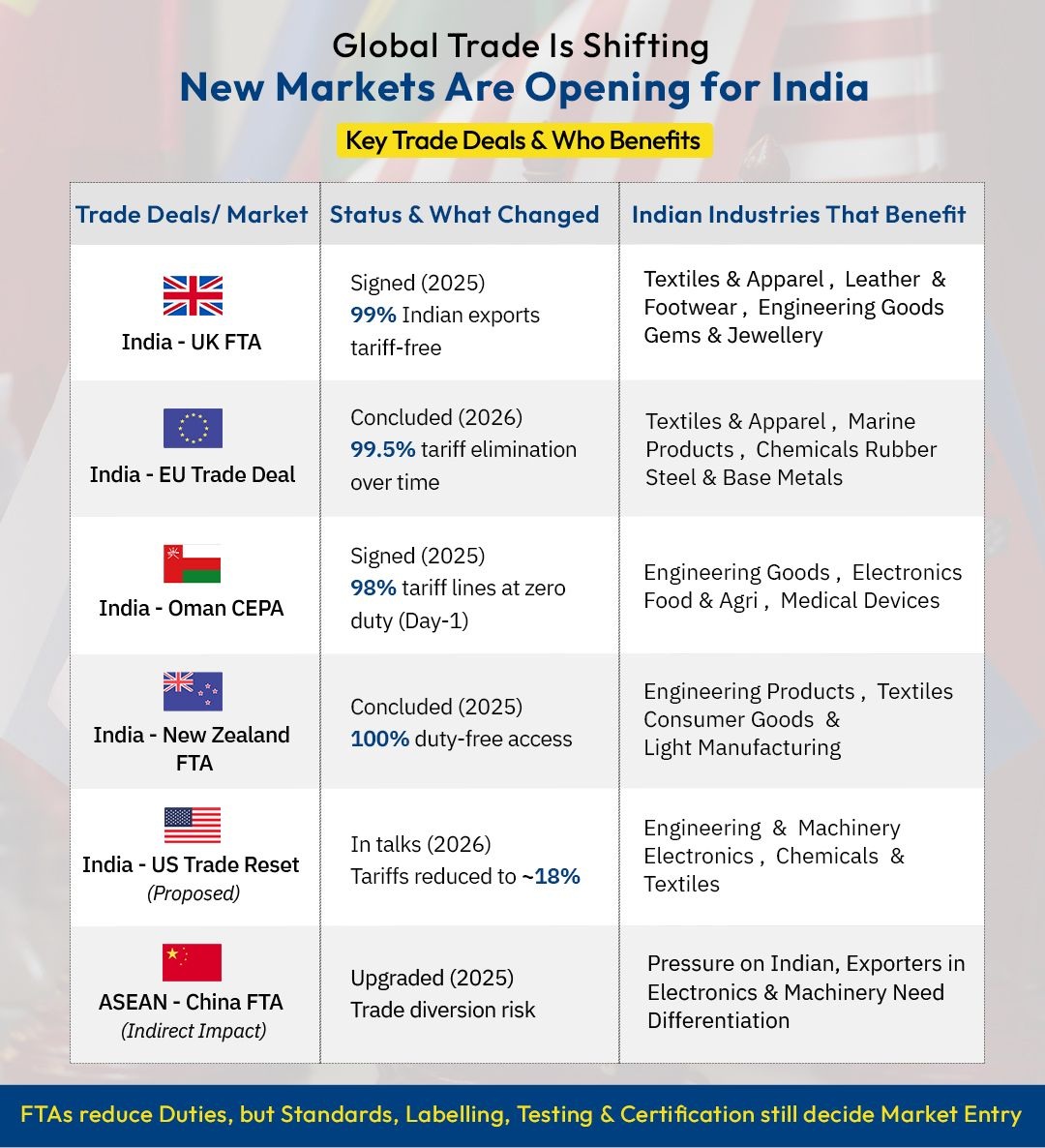
Tariffs Are Falling—But 90% of Indian Exporters Still Can’t Enter Global Market...

Trade policy sounds boring until it shows up in real life. Until...

Introduction A sort of conformity assessment known as CB certification verifies that...

How would you go about requesting an SASO Certificate of Conformity? If...

Overview of the Saber Certificate Companies registered in the Kingdom of Saudi...

Introduction International commerce is vital to the economies of many countries in...

How much does the Saber Certificate cost Recognizing the Saber Certificate Cost...