
SASO
Saudi Standards, Metrology and Quality Organization: the authority that develops Saudi technical regulations, standards, and product-conformity requirements.
Saudi Arabia · SASO / SABER
Saudi product conformity for regulated products is managed through the SABER platform under SASO requirements. The process mainly involves a Product Certificate of Conformity (PCoC) for the product and a Shipment Certificate of Conformity (SCoC) for each shipment. Markek supports the process from classification and documentation to shipment readiness.
People often use SASO Certification and SABER Certification interchangeably, but technically they mean different things. SASO is Saudi Arabia’s standards and technical-regulation authority, while SABER is the electronic platform used to manage product conformity. For regulated products, the actual conformity certificates are the PCoC, which confirms product conformity, and the SCoC, which applies to each shipment.
OVERVIEW
Manufacturers and exporters often refer to Saudi product conformity as “SASO Certification” or “SABER Certification.” The terms are commonly used for the same compliance journey, but technically each has a different role.
Saudi Standards, Metrology and Quality Organization: the authority that develops Saudi technical regulations, standards, and product-conformity requirements.
The electronic platform through which applicable products are registered and conformity processes are managed.
The actual conformity certificates used for regulated products through SABER.
The wider product-safety framework is SALEEM, which classifies products by risk and determines the technical regulations that apply.
For regulated products, the process generally works in two stages:
The product is assessed against the applicable Saudi technical regulation. The application is submitted through the Saudi importer’s SABER account to an approved conformity assessment body.
A separate shipment certificate is requested for each consignment using the product and invoice information.
THE TWO CERTIFICATES
| Comparison | PCoC | SCoC |
|---|---|---|
| Full name | Product Certificate of Conformity | Shipment Certificate of Conformity |
| Covers | The product | A shipment/consignment |
| How often | Obtained, then renewed annually | Every shipment |
| Validity | Typically up to 1 year | One consignment |
| Based on | Conformity assessment of the product | A valid PCoC + the commercial invoice |
| Purpose | Confirms conformity | Supports customs clearance |
| Issued in | A few working days | Same or next working day |
SASO describes the product conformity certificate as evidence that a product meets applicable technical requirements, while the shipment certificate is issued for commercial consignments through SABER.
WHO NEEDS IT
Foreign manufacturers exporting regulated products to Saudi Arabia
Exporters and trading companies supplying the Kingdom
Saudi importers and distributors
Local manufacturers placing applicable products on the Saudi market

BY INDUSTRY
Many consumer and industrial products imported into Saudi Arabia are managed through SABER. The exact route depends on the product classification and applicable technical regulation.
| Product Category | Typical SABER Route | May Also Require |
|---|---|---|
| Electrical & electronic products | PCoC + SCoC | Energy efficiency, G-Mark, or any other product-specific approval |
| Home appliances | PCoC + SCoC | Energy efficiency requirements |
| Toys | PCoC + SCoC | G-Mark and safety testing |
| Automotive parts, tyres, batteries | PCoC + SCoC | Product-specific SASO requirements |
| Building & construction materials | PCoC + SCoC | Saudi Quality Mark (SQM) for some categories |
| Textiles & apparel | PCoC + SCoC | Labeling and chemical requirements |
| Machinery & industrial equipment | PCoC + SCoC | Applicable technical regulations |
Final applicability should always be checked against the exact product specifications and HS classification.
BOOK A FREE AUDIT
CERTIFICATE TYPES
PROCESS
Classification
HS code & regulation
Testing
Review test evidence
PCoC
Product certification
SCoC
Invoice & shipment details
Shipment clearance
Complete the certificate process
Renew for future shipments. Track the PCoC expiry date and renew before future shipments are affected.
Confirm the 12-digit HS code and product status, and identify the applicable SASO technical regulation and standards.
Review available test reports and identify whether additional testing is required. Existing international reports such as IEC/CB may support conformity where the applicable regulation and assessment route allow them.
Prepare the technical documentation and submit the application through the Saudi importer’s SABER account to the appropriate conformity assessment body. SASO’s process includes selecting a conformity assessment body, application review, and a certification decision.
Create the shipment request using the relevant product certification, invoice, and shipment information.
Complete the shipment-certificate process before customs clearance. SASO specifically advises suppliers to prepare conformity or self-declaration documentation through SABER before shipping.
Track the product certificate’s expiration date and renew it before future shipments are affected.
DOCUMENTATION
Product technical file
Test evidence, labels & manufacturer details
PCoC
Product Certificate of Conformity
Shipment file
Invoice, consignment & applicable conformity details
SCoC
Shipment Certificate of Conformity
SASO confirms that product-certificate applications require technical-file contents based on the technical regulation and product type.
SASO’s shipment-certificate workflow requires product selection, invoice details, quantities, values, and shipment-country information.
TIMELINE & VALIDITY
| Stage | Typical time |
|---|---|
| Classification | 1–2 working days |
| Testing | Depends on product and existing reports |
| PCoC | Depends on document readiness and assessment |
| SCoC | Same or next working day (After shipment information is available) |
For reference, SASO currently lists an estimated 8 working days for its product conformity certificate registration service and 3 working days for its imported commercial-product shipment certificate service. Depending on product category, test-report availability, conformity-assessment requirements, and completeness of the technical file, actual project timelines may vary.
8 working days
Estimated service period
3 working days
Service period
REGULATORY UPDATES
Saudi requirements continue to evolve, so exporters should avoid relying on old HS-code lists or previous shipment practices.
SASO states that regulated products require product conformity certification followed by shipment certification, while non-regulated products use self-declaration followed by the shipment process.
PCoC
Product conformity certification
SCoC
Shipment certification
Self-declaration
Supplier declaration of conformity
SCoC
Shipment certification
Saudi Arabia introduced the integrated GCC customs tariff at the 12-digit level from . Product classification should therefore be checked against the current tariff rather than older codes.
SASO advises suppliers and customs agents to determine product status, coordinate conformity assessment where required, and prepare SABER documentation before dispatch.
Last reviewed:
REGULATORY UPDATES
Saudi requirements continue to evolve, so exporters should avoid relying on old HS-code lists or previous shipment practices.
SASO states that regulated products require product conformity certification followed by shipment certification, while non-regulated products use self-declaration followed by the shipment process.
PCoC
Product conformity certification
SCoC
Shipment certification
Self-declaration
Supplier declaration of conformity
SCoC
Shipment certification
Saudi Arabia introduced the integrated GCC customs tariff at the 12-digit level from . Product classification should therefore be checked against the current tariff rather than older codes.
SASO advises suppliers and customs agents to determine product status, coordinate conformity assessment where required, and prepare SABER documentation before dispatch.
Last reviewed:
COST & MISTAKES
There is no single SABER certification price for every product. The overall cost can vary based on:
Product category and risk level
Number of models or product families
Testing requirements
Conformity assessment route
Factory audits where applicable
Number and frequency of shipments
Starting with an incorrect HS code may lead to the wrong certification route.
Complete the required SABER documentation before the shipment reaches Saudi customs.
Missing test reports, labels, or product information can delay assessment.
Track renewal dates against upcoming shipments.
Not every product follows the same Saudi compliance route.
Products with ICT or wireless functions may also require CST assessment depending on their technical features.
MARKEK SUPPORT
Markek International Certifications supports manufacturers, exporters, and importers through the Saudi product conformity process.
Classification
Testing review
PCoC coordination
Shipment support
We review your product details and HS code to identify the applicable technical regulation and certification route before unnecessary testing begins.
We coordinate with appropriately accredited laboratories and review existing reports to determine whether additional testing is required.
We prepare and review the conformity documentation and coordinate the PCoC process through the appropriate approved conformity assessment route.
Once the product certification is in place, we coordinate SCoC documentation with the Saudi importer for upcoming shipments.
Markek’s source material identifies the organization as operating under the ISO/IEC 17065 product certification and ISO/IEC 17020 inspection frameworks, with experience across multiple international markets.
They are often used interchangeably, but technically they are not the same. SASO is the authority that develops Saudi standards and technical regulations, while SABER is the electronic platform used to manage product conformity. For regulated products, the actual conformity certificates are the PCoC and SCoC.
SABER Certification is a commonly used term for the Saudi product conformity process that is managed through the SABER platform. For regulated products, the process generally involves a PCoC for the product and an SCoC for each shipment.
The PCoC relates to product conformity, while the SCoC relates to an individual shipment. Regulated products generally complete product certification before shipment certification.
For a regulated product requiring a PCoC, the applicable product conformity process must be completed before its shipment certificate can be finalized. Non-regulated products follow the self-declaration route instead.
The Saudi-side supplier or importer manages the SABER account, while the foreign manufacturer or exporter provides the technical and conformity documentation required for the product.
Validity depends on the applicable product and certification route. Where a certificate is time-limited, renewal should be planned before upcoming shipments.
Yes. SASO states that non-regulated products use a self-declaration process and then complete the applicable shipment-certificate procedure.
Possibly. Existing reports may support the assessment where their standards, product coverage, and laboratory credentials meet the applicable Saudi requirements.
ICT equipment may require separate CST approval depending on the product and applicable CST technical specifications. This should be checked during classification rather than assumed based on the presence of a wireless feature alone.
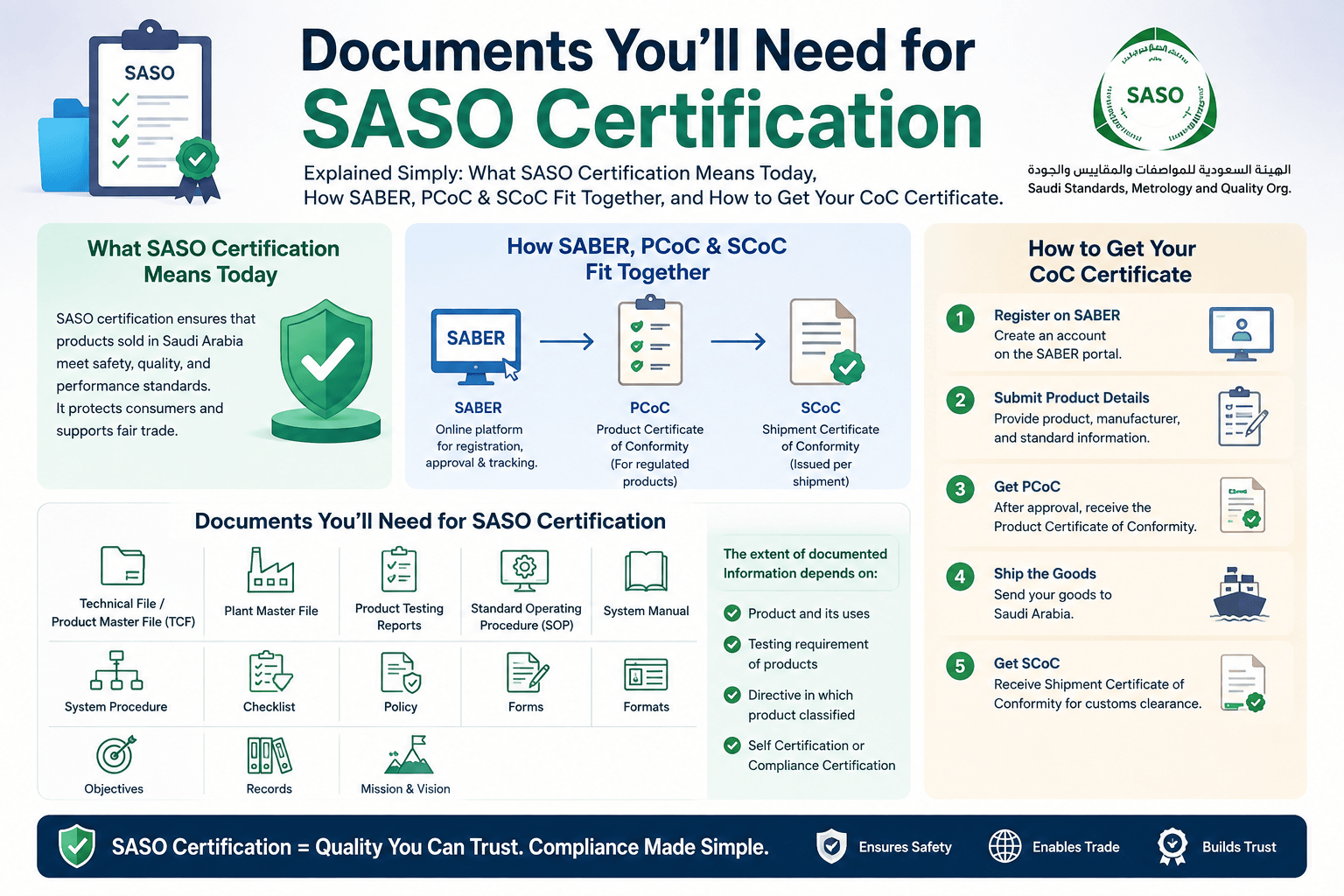
Most people who search for "certification SASO" have already lost time. A...

Most exporters believe global expansion fails because markets are difficult to enter.That’s...
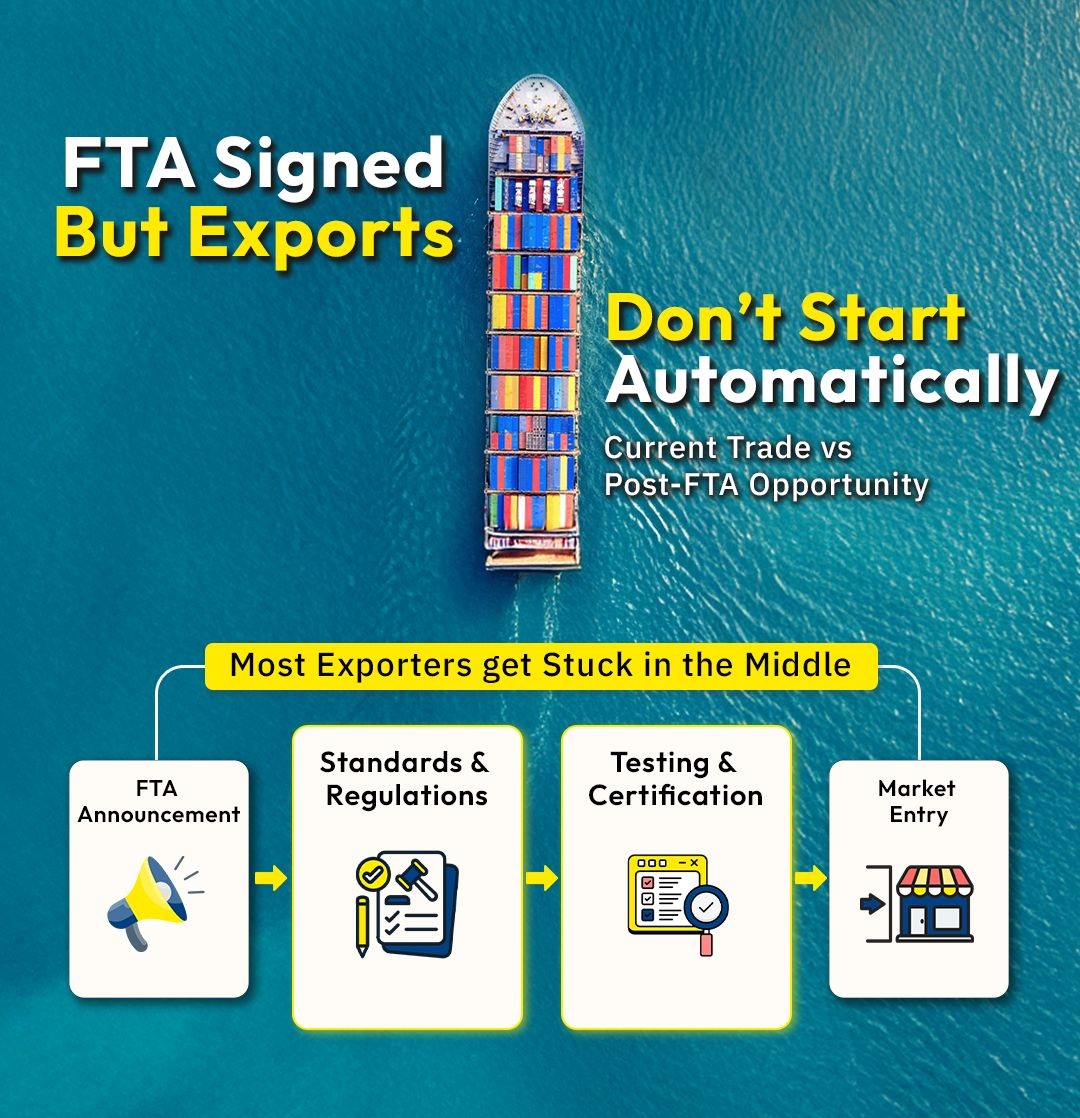
In today’s rapidly evolving global trade landscape, new FTA agreements are being...
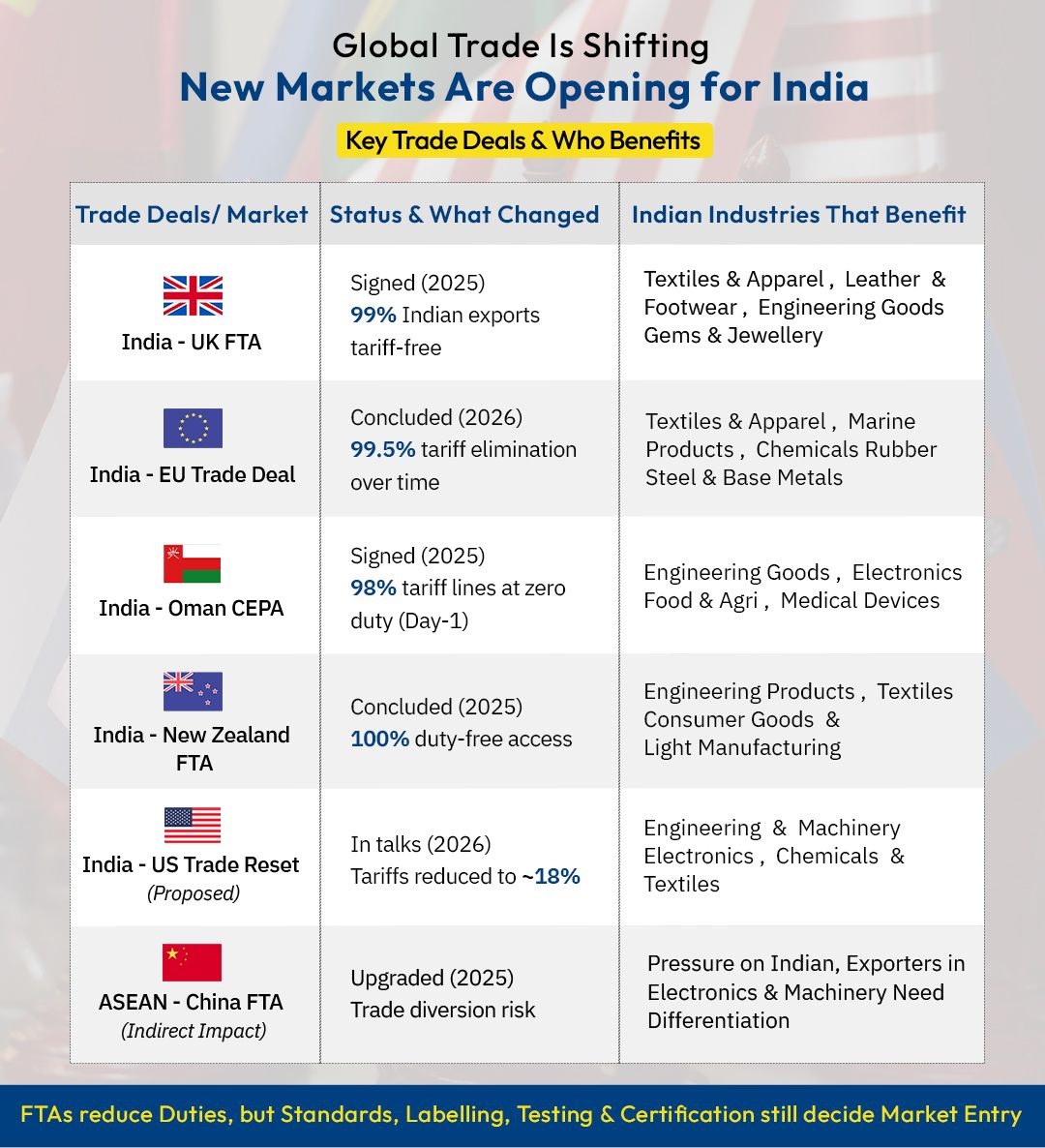
Tariffs Are Falling—But 90% of Indian Exporters Still Can’t Enter Global Market...

Trade policy sounds boring until it shows up in real life. Until...

Introduction A sort of conformity assessment known as CB certification verifies that...

How would you go about requesting an SASO Certificate of Conformity? If...

Overview of the Saber Certificate Companies registered in the Kingdom of Saudi...

Introduction International commerce is vital to the economies of many countries in...

How much does the Saber Certificate cost Recognizing the Saber Certificate Cost...