
1. Foreign Establishment Registration
- Who:
- Overseas manufacturer or exporting establishment
- Purpose:
- Registers the foreign source supplying food to Saudi Arabia
Saudi Arabia · Food Compliance
People who commonly search for SFDA Food Certification are often directed to the SFDA route instead of the regular SABER product conformity route for all kinds of food products being imported into Saudi Arabia. The food products have to be registered properly, comply with Saudi food labeling and safety requirements, and go through the necessary import-clearance process.
“SFDA Food Certification” is commonly used to describe the Saudi food compliance process, but there is no single universal food certificate. Foreign food establishments and Saudi importers and food products must be registered as applicable, while each shipment must separately meet SFDA import and clearance requirements. Food product registration/listing services are now managed through GHAD.
OVERVIEW
The Saudi Food and Drug Authority (SFDA) regulates imported food, beverages, and food ingredients entering Saudi Arabia. Unlike many consumer and industrial products, food follows the SFDA route rather than SABER.
The process has three important registration layers:
The foreign food establishment exporting to Saudi Arabia.
The Saudi importer responsible for placing the food on the market.
The food product itself before import.
SFDA confirms that overseas food establishments must register, while the importer completes product registration before importation.
In July 2025, the GHAD unified platform took over food product registration/listing services, while import and clearance services remained separate.

WHO NEEDS IT
Foreign food and beverage manufacturers exporting to Saudi Arabia
Exporters of packaged food, ingredients, and bulk food
Saudi food importers and distributors
Brand owners supplying products through Saudi importers
Talk to a Food Compliance Expert
SCOPE
Most imported food categories fall under SFDA oversight. The exact requirements depend on the product, ingredients, intended use, and applicable Saudi food regulations:
Packaged foods & beverages
Dairy & animal-derived products
Edible oils, sugar, staples
Food ingredients & additives
Nutritional / functional foods
Meat & poultry
Bulk food
REGISTRATION STRUCTURE
PROCESS
Product review
Category, ingredients, and intended use
Registration
Foreign establishment, Saudi importer, and food product
Shipment & clearance
Documents, labeling, and remaining shelf life
Review the product, ingredients, and intended use to identify the applicable SFDA food requirements.
Submit the required information on the establishment, along with the required industrial/regulatory documents.
It is important that your Saudi importer holds the correct commercial activities and has an SFDA account for imported food products.
Prepare all the required information related to the product, its contents, origin, labeling, storage conditions, etc., and register the product via the relevant GHAD food service.
Clarify any doubts or questions from the SFDA until one meets all the requirements for registration.
Compile all relevant product and shipment documents for import clearance by the SFDA. Present the certificate at the port, meeting the shelf-life-remaining rule and labeling requirements on the consignment.
DOCUMENTATION
SFDA specifically lists registration and industrial certificates for foreign food establishments, with additional quality requirements for certain meat, poultry, and fish establishments.
TIMELINE & VALIDITY
There is no single registration timeline for every food product. Processing depends on the product category, completeness of the submission, and whether SFDA requires additional technical review or supporting information.
Registration should therefore be started well before the planned shipment date, particularly for special or more complex food categories.
Food must comply with SFDA.FD 150-1 and SFDA.FD/GSO 150-2, which SFDA identifies as the relevant Saudi expiry and shelf-life standards.
LABELING & HALAL
Correct registration alone is not enough. The product itself must also comply with the applicable Saudi food requirements.
Prepackaged food labeling must be in Arabic. Another language may appear alongside Arabic, but the information must match the Arabic text. Food labeling requirements are primarily governed by SFDA.FD/GSO 9, with additional nutrition or claim requirements applying where relevant.
Halal slaughter certification is mandatory for applicable shipments of meat, poultry, and their products and must come through a recognized Halal certification route.
COST
There is no single cost for every SFDA food registration project. The total depends on:
Products with different mandatory registration information may need to be treated separately, so the product range should be reviewed before estimating cost.
COMMON MISTAKES
Food products follow SFDA food requirements, not the standard SABER conformity process.
Overseas exporting establishments must also be registered.
Review the label before printing, not after the goods arrive.
Ingredients, origin, pack size, and other product information should remain consistent.
Plan production and shipping around the applicable expiry requirements.
Completing product registration does not remove the need for shipment-level SFDA clearance.
Markek Support
Markek supports manufacturers, exporters, and Saudi importers through the food registration and import-readiness process.
We review the food category, ingredients, and route to identify the applicable registration, labeling, and supporting-document requirements.
We coordinate the foreign-establishment setup and food-product registration through the applicable SFDA route and approved partners.
We help get the Arabic label right and plan around the remaining shelf life so shipments aren’t rejected.
One point of contact from registration to the SFDA certificate that releases your goods.
Food products imported commercially into Saudi Arabia fall under SFDA requirements. Individual registration of the importer, foreign establishment, and applicable food products is compulsory, and each food shipment must comply with the relevant SFDA import and clearance requirements.
SFDA Food Certification” is a common search term, but food registration is usually the more accurate description. There is no single universal SFDA food certificate covering the entire process.
Food follows the SFDA food-compliance route rather than the standard SABER product-conformity process.
GHAD is SFDA’s unified electronic platform. Food product registration/listing services moved to GHAD in July 2025, while food import and clearance services are handled separately.
The Saudi importer registers food products before they are imported. The overseas establishment supplying those products must also be registered with SFDA.
SFDA currently requires Halal slaughter certification for imported shipments of meat, poultry, and their products. Other products should be checked according to their ingredients and applicable requirements.
Yes. Food labeling must be in Arabic. Additional languages may be used alongside Arabic, provided the information is consistent with the Arabic text.
SFDA may require or initiate random testing of food products based on its category, documents, inspection findings, or other compliance considerations.
The food registration timeline depends on its category, documentation, and the level of technical review required. For example, a special or more complex food category could take a few months compared to a common food ingredient, which could finish within a couple of weeks.
A registered food shipment/consignment may still face issues if it does not meet its labeling, documents, Halal requirements, expiry, storage conditions, or other applicable import requirements. Registration does not replace shipment compliance.
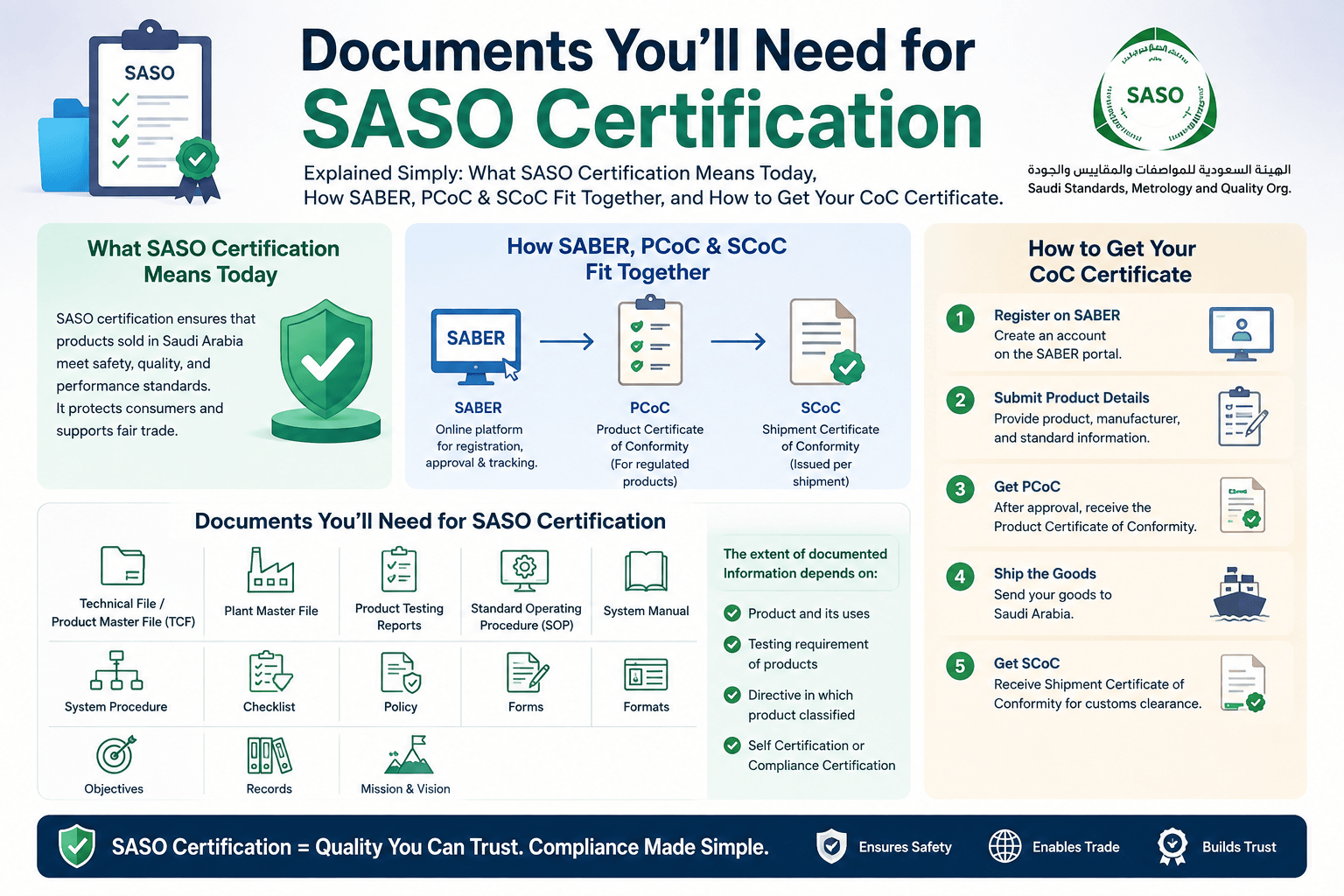
Most people who search for "certification SASO" have already lost time. A...

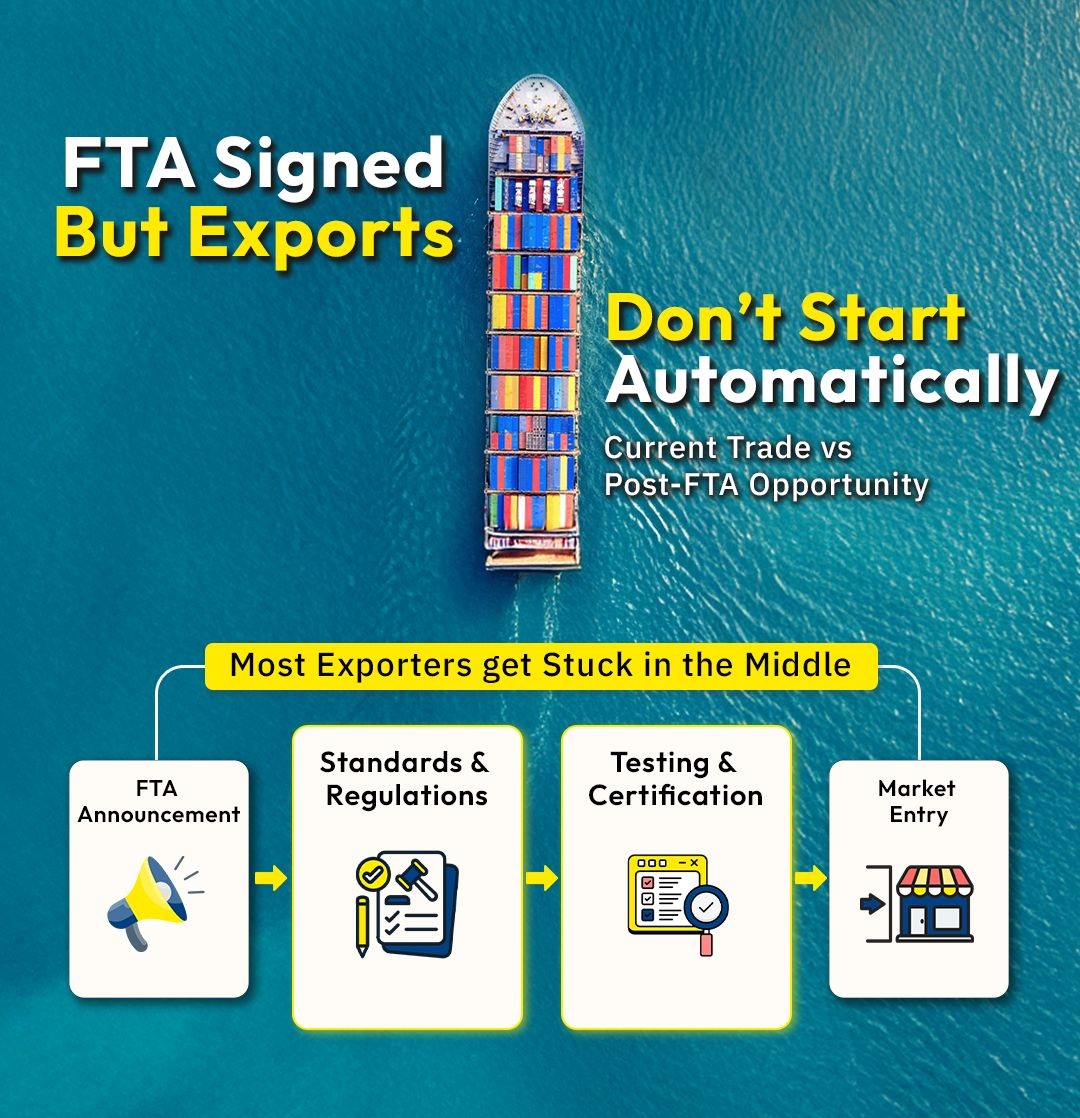
Most exporters believe global expansion fails because markets are difficult to enter.That’s...
In today’s rapidly evolving global trade landscape, new FTA agreements are being...
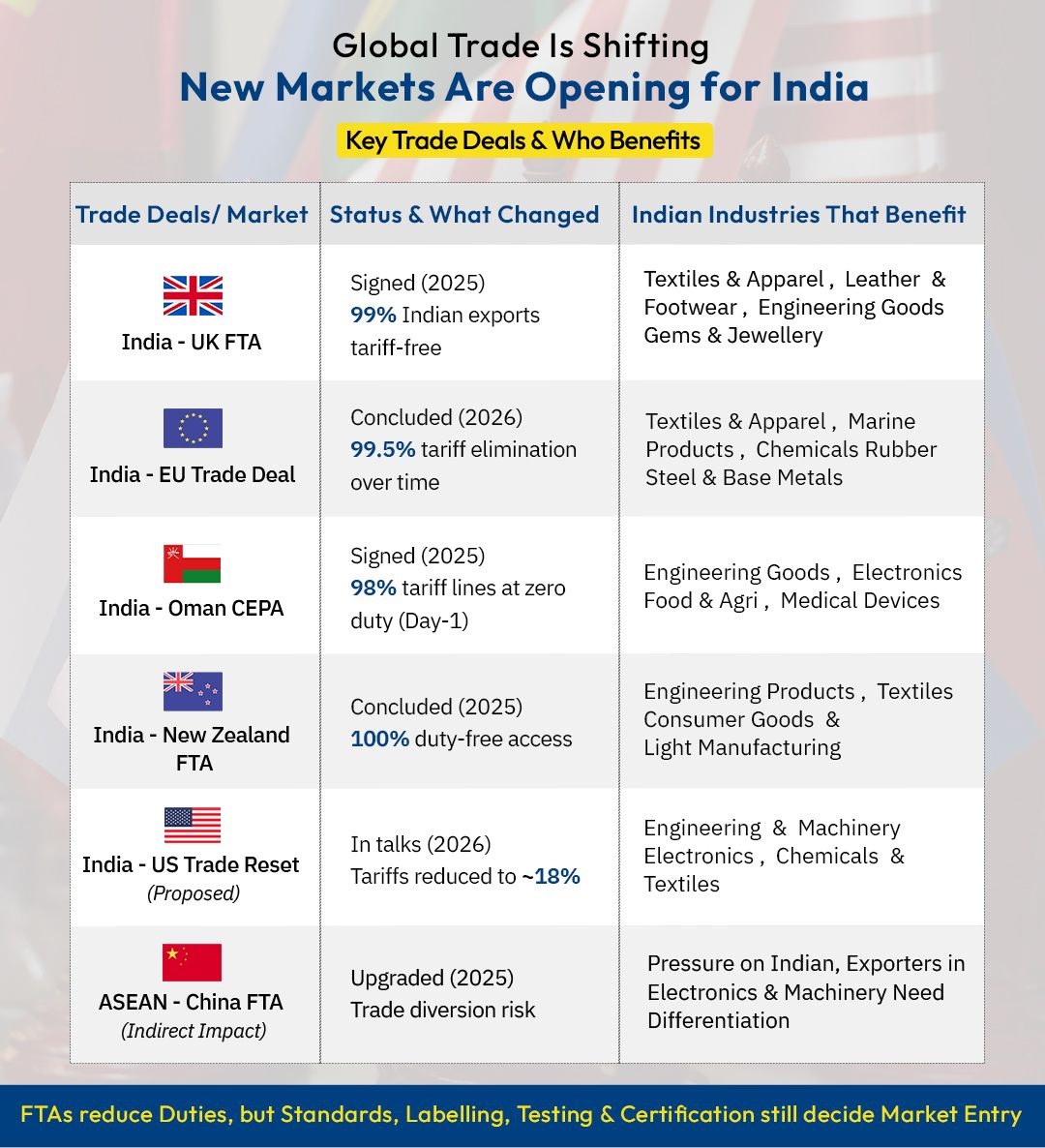
Tariffs Are Falling—But 90% of Indian Exporters Still Can’t Enter Global Market...

Trade policy sounds boring until it shows up in real life. Until...

Introduction A sort of conformity assessment known as CB certification verifies that...

How would you go about requesting an SASO Certificate of Conformity? If...

Overview of the Saber Certificate Companies registered in the Kingdom of Saudi...

Introduction International commerce is vital to the economies of many countries in...

How much does the Saber Certificate cost Recognizing the Saber Certificate Cost...