Pre-Shipment
Compliance Before Export
Global Market Access Iraq
Iraq uses different pre-shipment documents depending on the product. Goods covered by the Federal Iraq Verification of Conformity (VoC) programme generally require a Certificate of Conformity (CoC) before export. Goods outside that scope may instead need a Certificate of Inspection (COI) when inspection is requested. Frequent exporters can use Route B product registration to streamline repeat VoC shipments; each shipment still requires its own CoC.
Compliance Before Export
Based on Product Scope
For Repeat VoC Shipments
At a Glance
Federal Iraq applies pre-shipment controls according to product scope. Products regulated under the Iraq Verification of Conformity (VoC) programme require a Certificate of Conformity (CoC) for each shipment. Goods outside VoC may instead be covered by the IQB inspection scheme and require a Certificate of Inspection (COI), depending on the current scope, exemptions, and shipment terms. Frequent exporters of VoC-regulated goods can use Route B product registration to simplify later assessments, but must still obtain a CoC for each shipment.
How it works
The Central Organization for Standardization and Quality Control (COSQC) and other relevant Iraqi authorities oversee product standards and conformity. For exports to Federal/Central Iraq, three routes are especially relevant:
Products covered by the Iraq Verification of Conformity (VoC) programme undergo document review, testing where required, and pre-shipment inspection before a CoC is issued. COSQC appoints certification bodies to operate the programme.
Goods outside the VoC programme may instead fall under the IQB inspection scheme, which can involve pre-shipment inspection and a Certificate of Inspection (COI). Some products are exempt from IQB and remain subject to controls by COSQC, the Ministry of Health, or other Iraqi authorities.
Manufacturers or exporters regularly shipping the same regulated product can register it under Route B. A valid Statement of Registration can support multiple shipments for one year, with selective inspection and random testing of later consignments. A CoC is still issued for each shipment.
Who Needs It
For products regulated under Federal Iraq’s VoC programme, these parties typically coordinate the CoC process:
By Industry
Iraq’s conformity programme covers a broad range of regulated imports. Current programme information identifies sectors including the following:
| Industry / Product Group | Typical Compliance Focus |
|---|---|
| Food & Beverages | Iraqi standards, labeling, and health and food documentation |
| Construction Materials | Product-specific Iraqi standards and testing |
| Electrical & Electronics | Safety, performance, electrical requirements, and labeling |
| Vehicle Parts & Tires | Applicable automotive and safety requirements |
| Chemicals | Technical specifications, analysis, and safety documents |
| Lubricants | Product specifications and applicable testing |
| Cosmetics & Perfumery | Composition, labeling, and applicable Iraqi standards |
| Toys & Baby Care Items | Product safety requirements |
| Textiles & Apparel | Fiber and content information, plus product requirements |
| Kitchenware & Household Goods | Material and product conformity |
| Stationery | Applicable product standards |
| Tobacco Products | Product-specific Iraqi controls |
Complete this classification before planning testing, inspection, or shipment.
Certification Routes
Iraq VoC programme guidance describes two main exporter routes. The right one depends largely on whether this is an occasional consignment or a product you ship regularly.
Occasional or first-time exports
Each consignment is assessed on its own. The route may involve:
Best suited to: occasional exports, first shipments, or products not shipped regularly.
Regular exports of the same product
The product first undergoes conformity assessment. Once accepted, a Statement of Registration can support multiple shipments for one year.
Best suited to: manufacturers and exporters making repeat shipments of the same regulated product.
Regular exporter? Review whether a one-year registration could simplify your repeat shipments.
Process
For regulated products in Federal Iraq’s VoC programme, the route is established first, then the product and shipment are assessed before export.
Route planning
Determine whether the product falls within the regulated VoC scope and identify the applicable Iraqi standard or technical requirement.
Route planning
Use the product type and expected shipment frequency to choose consignment assessment or product registration.
Before shipment
Prepare the application with commercial, product, manufacturer, exporter, and Iraqi importer information.
Before shipment
Review existing test reports against the Iraqi requirement. Arrange laboratory testing where current evidence is insufficient.
Before shipment
Inspect the actual goods in the country of supply or export, checking identification, quantity, marking, packaging, and consistency with the submitted documents.
Certificate issued
When the document review, test evidence, and inspection are satisfactory, the Certificate of Conformity is issued before shipment.
On arrival
At the Iraqi port or border, the shipment and certificate are verified. Programme guidance describes destination inspection and release-document checks after arrival.
Documentation
The exact documents depend on the product and certification route. Manufacturers and exporters should generally prepare the following for review.
Depending on the product, additional evidence may include:
Current Iraq programme application guidance reflects these document categories. Confirm the final checklist against the product, route, and applicable Iraqi requirements before submission.
Kurdistan Region
The Kurdistan Region operates a separate Consignment Based Conformity Assessment (CBCA) programme from the Federal Iraq compliance routes covered on this page.
Kurdistan Region
Intertek currently states that it is the sole Certification Body authorised to issue Certificates of Conformity for regulated consignments exported to the Kurdistan Region.
Markek service scope
Markek’s current Iraq product-compliance services focus on Federal/Central Iraq and do not include Kurdistan CBCA certification.
2026 Regulatory Update
Older guidance can be misleading. The Iraqi Quality Mark’s status changed in 2026, but the pre-shipment Certificate of Conformity (CoC) requirement for regulated imports remains.
Iraq moved toward mandatory Iraqi Quality Mark requirements for certain imported products, particularly electrical products.
The decision changed that position. Current programme guidance confirms that the Iraqi Quality Mark is optional, rather than mandatory.
COSQC continues to offer an electronic service for applying for the Iraqi Quality Mark for imported products.


Looking for the Best Learning and Development Software? Check out the
Markek’s Compliance Insight
Many exporters assume Saudi certification happens after shipment planning. In reality, product classification and approval must happen before commercial shipment. Early compliance planning significantly reduces cost, testing repetition, and customs delays.
Timeline & Cost
There is no single Iraq certification timeline or cost. The work changes depending on whether the product follows the VoC CoC route, the IQB COI route, or Route B registration.
Timing depends on the technical evidence, any fresh testing, document readiness, and the pre-shipment inspection schedule.
The process is primarily documentary review and physical inspection, with additional assessment where the scheme requires it.
Route B adds an upfront product-registration assessment. During the registration period, later shipments can use selective inspection and random testing instead of repeating the full initial assessment.
Common Mistakes
Products outside the VoC scope may instead fall under the separate IQB inspection scheme.
Many non-VoC products still require an IQB Certificate of Inspection, while some categories fall under other Iraqi authority controls.
VoC certification and IQB inspection are designed to be completed before export.
Product standards and imported-product requirements continue to change.
Frequent VoC exporters should assess whether Route B registration is more efficient.
Shipment documentation must remain consistent throughout the process.
The Quality Mark became optional in 2026; it should not be confused with the separate CoC requirement for regulated imports.
Kurdistan operates a separate CBCA route, which is managed by Intertek.
Food, chemicals, cosmetics, and other categories can require health, Halal, phytosanitary, composition, safety, or other supporting evidence.
Markek Support
Markek focuses on three Federal Iraq compliance pathways:
We review the product, HS code, destination, and shipment pattern to determine whether it falls under the VoC CoC route, IQB COI route, or Route B registration.
For regulated VoC products: We review existing test evidence, coordinate laboratory testing where needed, prepare the certification file, and coordinate pre-shipment inspection and CoC issuance through the applicable COSQC-authorized certification body.
For applicable non-VoC goods: We coordinate the separate IQB inspection and COI route through an Iraqi-authorized assessment company.
For frequent exporters, we coordinate the product-registration file and Statement of Registration so later VoC shipments can benefit from selective inspection and random testing rather than repeating the full initial assessment.
The main routes covered by Markek are the VoC Certificate of Conformity for regulated products, the IQB Certificate of Inspection for applicable products outside the VoC scope, and Route B Product Registration for frequent exporters of VoC-regulated products.
It is the pre-shipment CoC required for regulated goods covered by Iraq’s VoC program. The process can include technical-document review, testing, and physical inspection before shipment.
The IQB Scheme covers products outside the Iraq VoC program and certain other specified shipments. The applicable products are subject to an inspection and other evaluations prior to issuance of a Certificate of Inspection (COI).
Not automatically. The IQB Scheme includes exemptions, and some products remain subject to controls by COSQC, the Ministry of Health, or other Iraqi authorities at the destination. Product classification should therefore be confirmed before assuming the IQB route.
Route A is the standard VoC route for unregistered or occasional exports. The shipment is supported by test evidence/testing and pre-shipment inspection before the CoC is issued.
Route B allows frequent exporters to register a compliant product before repeat shipments. Current program guidance states that the registration can support multiple shipments for one year, with selective inspection and random testing on later consignments.
No. A CoC is still issued for each regulated shipment. Route B reduces the repeated product-assessment burden behind later CoCs.
The Federal Iraq VoC and IQB systems are designed around pre-shipment assessment. Applicable testing, inspection, and certification should therefore be completed before dispatch.
Upon arrival, the shipment will be evaluated at the destination. This includes evaluation of the CoC, documentation, and the product before release. This step is in addition to the pre-shipment CoC procedure.
No. Current VoC program information records the Iraqi Quality Mark scheme as optional following the 2026 change. This does not remove applicable VoC CoC or IQB requirements.
No. Markek’s current Iraq compliance offering focuses on Federal/Central Iraq. Kurdistan operates a separate CBCA program, and Intertek currently states that it is the sole authorized Certification Body for regulated consignments under that program.
Begin with the product description, HS Code, destination or point of entry, and shipment frequency. These determine whether the product follows the VoC CoC route or the IQB COI route, whether an exemption applies, and whether Route B registration makes commercial sense.
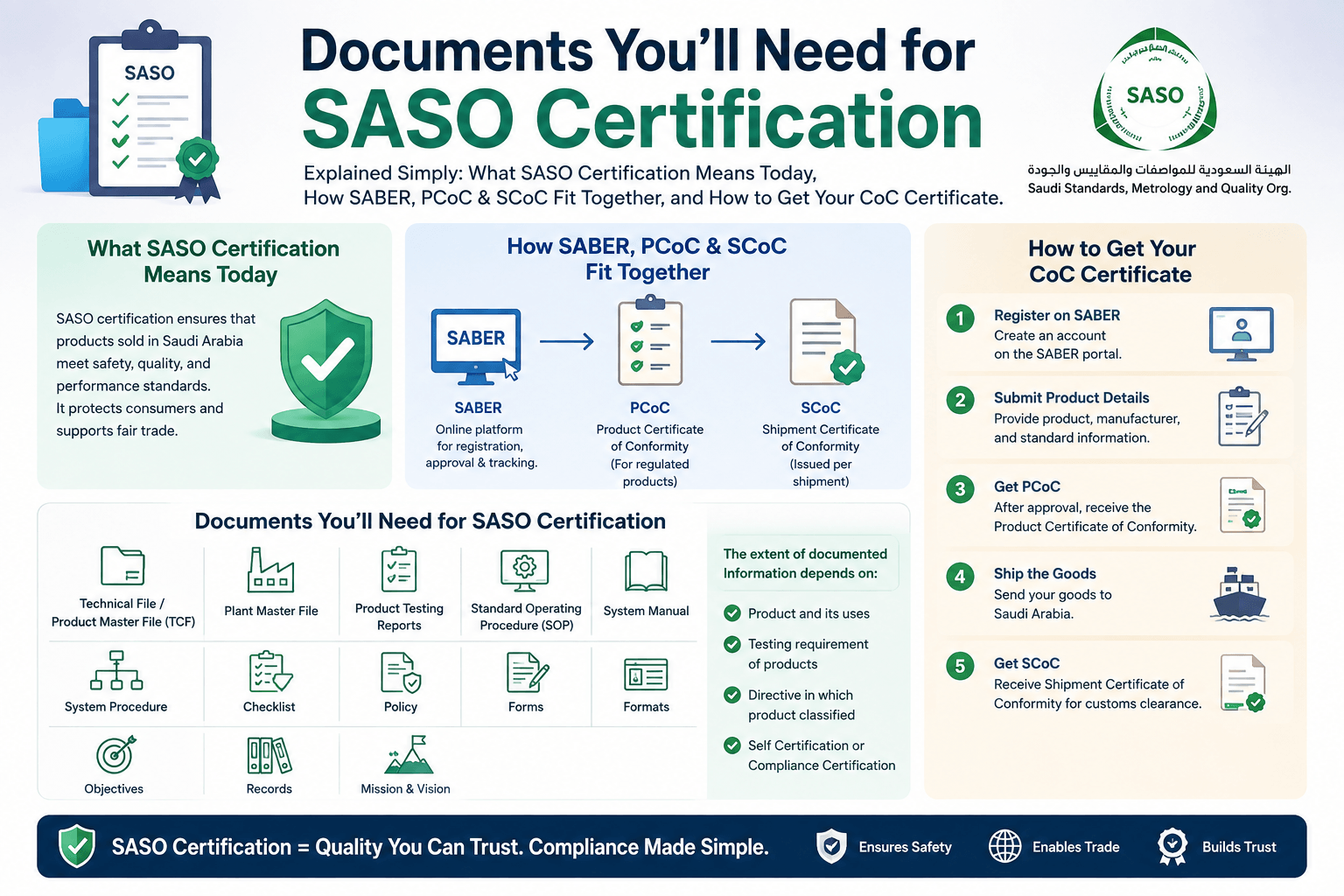
Most people who search for "certification SASO" have already lost time. A...

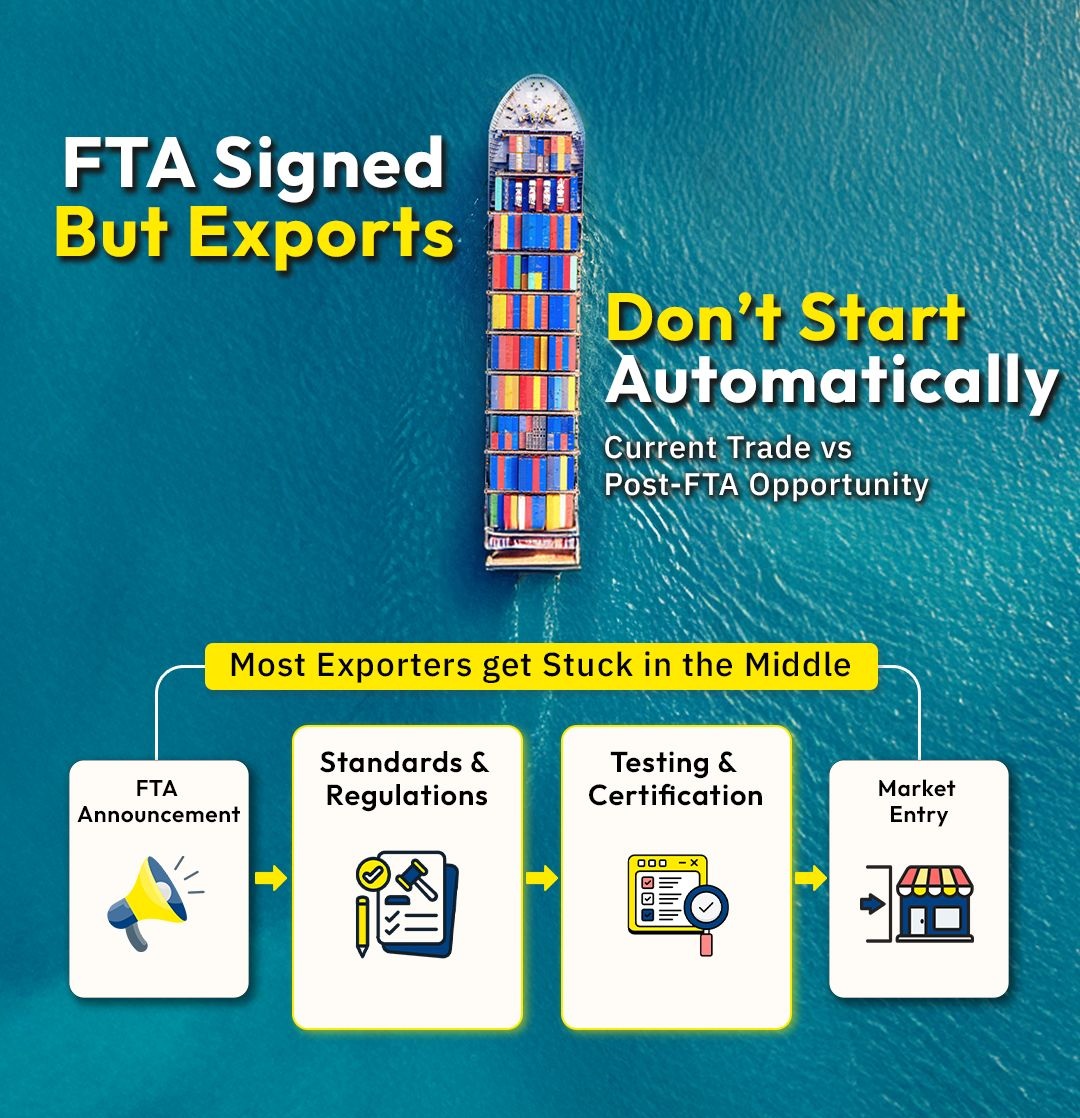
Most exporters believe global expansion fails because markets are difficult to enter.That’s...
In today’s rapidly evolving global trade landscape, new FTA agreements are being...
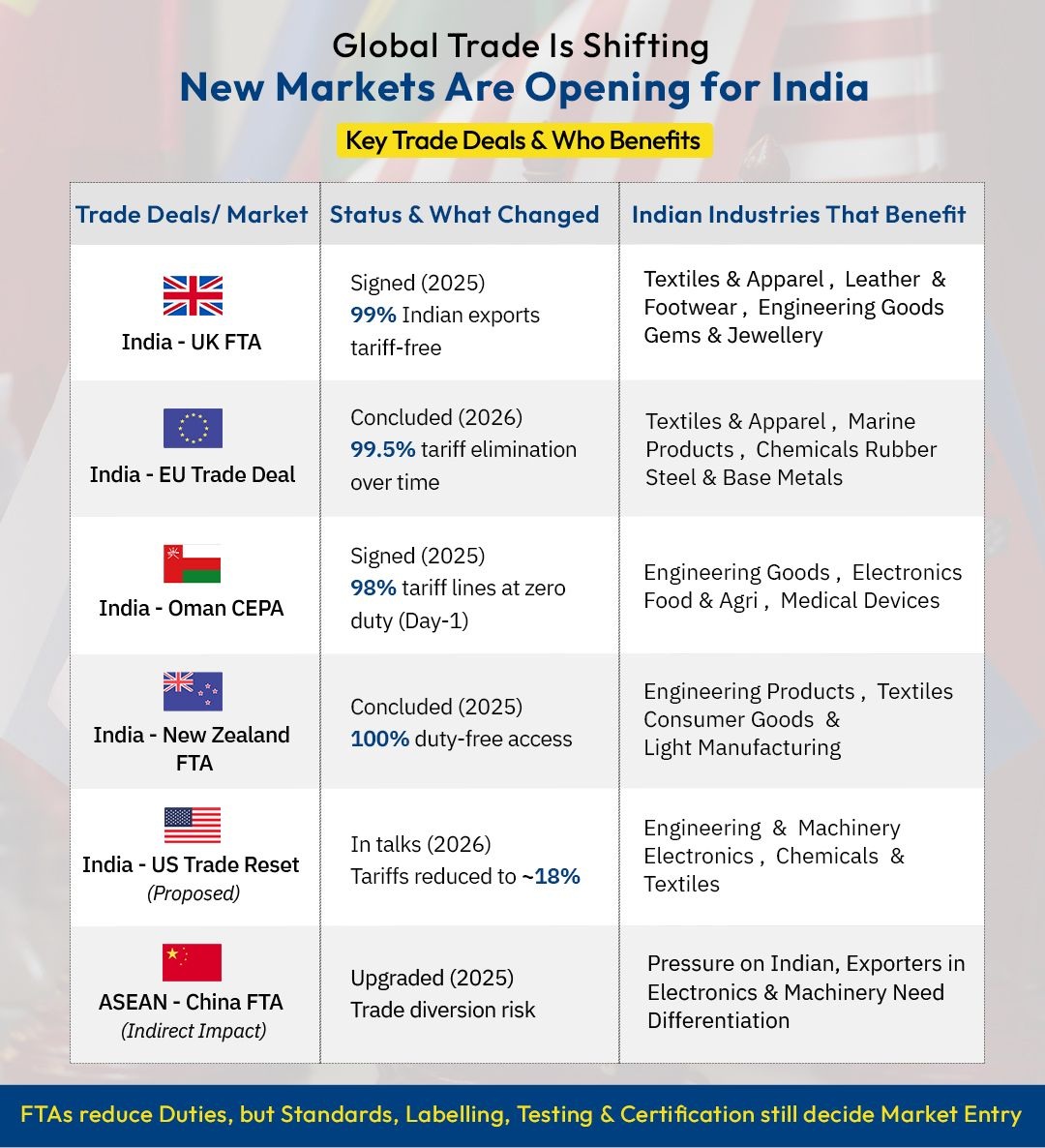
Tariffs Are Falling—But 90% of Indian Exporters Still Can’t Enter Global Market...

Trade policy sounds boring until it shows up in real life. Until...

Introduction A sort of conformity assessment known as CB certification verifies that...

How would you go about requesting an SASO Certificate of Conformity? If...

Overview of the Saber Certificate Companies registered in the Kingdom of Saudi...

Introduction International commerce is vital to the economies of many countries in...

How much does the Saber Certificate cost Recognizing the Saber Certificate Cost...