
PCoC + SCoC
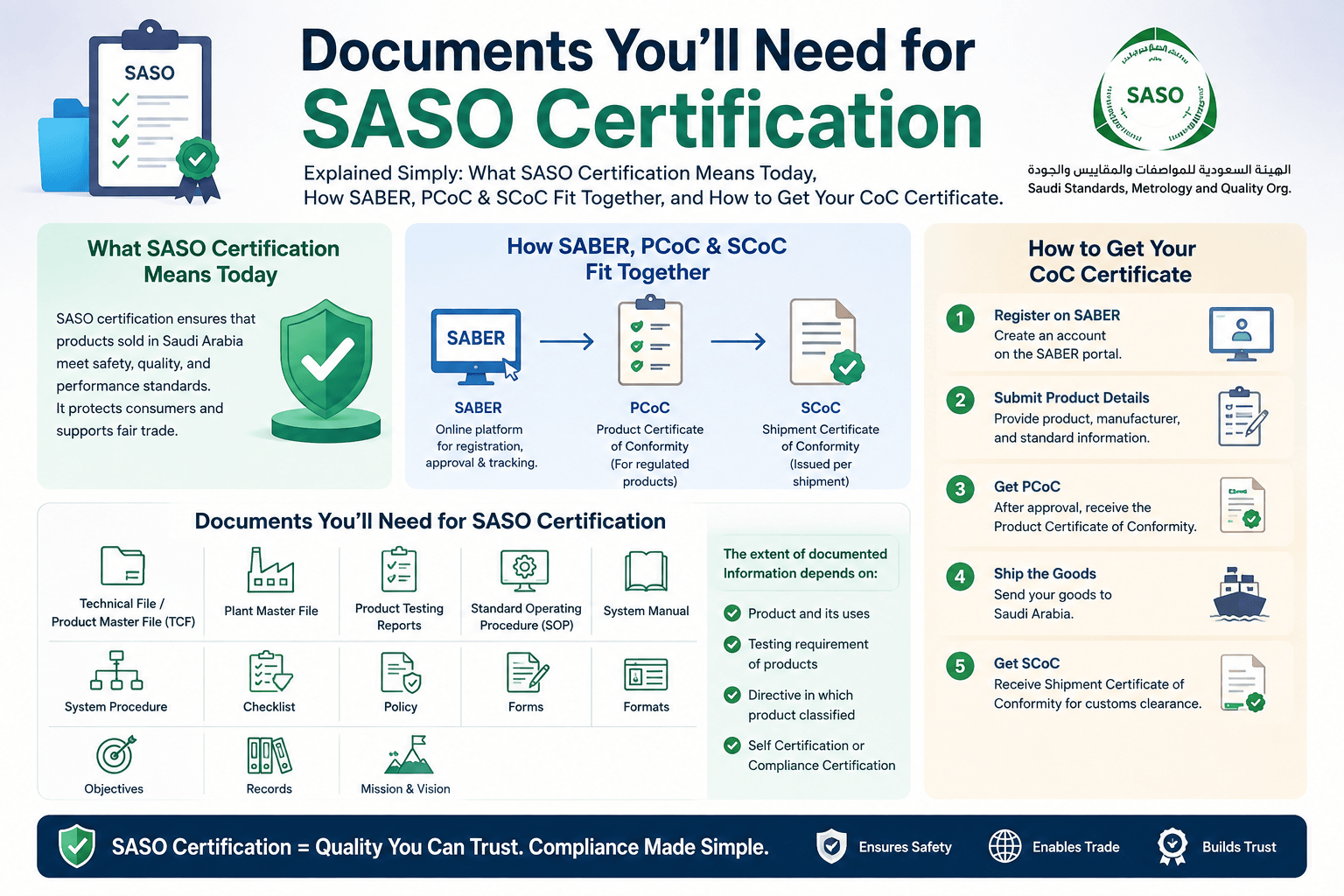
Two Certificates Required
Saudi Arabia · Product Compliance
End-to-end Saudi Arabia product certification for exporters, manufacturers and importers — SABER, SASO, SFDA, CST and the Saudi Quality Mark, managed by one accredited partner. Get your product approved before it ships, not after it is held at the port.
Two Certificates Required
Product Certificate Validity
Our Accreditation
At a Glance
Most products exported to Saudi Arabia require registration on the SABER platform, a Product Certificate of Conformity (PCoC) valid up to one year, and a Shipment Certificate of Conformity (SCoC) for every consignment. Food, cosmetics and medical devices are regulated separately by the SFDA. Wireless products additionally require CST type approval. A first certificate typically takes around 2–3 weeks.
Overview
Saudi Arabia controls product entry through several regulators. Three authorities are central to common product-certification routes:
For regulated products in the SABER route, product approval comes before shipment certification.
Confirms that the product meets the applicable Saudi technical regulation. Validity can be up to one year, depending on the product category and certificate.
Issued for each consignment using the relevant product certification and commercial shipment details. The required shipment certificate supports customs clearance.
Who Needs It
By Industry
The route depends on what you sell. Some products need one certification; others need several requirements working together.
Example 01 · Connected electronics
Bluetooth connectivity can bring more than one Saudi requirement into the same product route.
Example 02 · Construction materials
Cement adds a mandatory quality-mark route that examines the product and its manufacture.
| Industry / Product Category | Required Certification | Authority | Portal |
|---|---|---|---|
| Electrical & Electronic Products | SABER · Energy Efficiency (MEPS) where applicable · IECEE CB reports accepted as supporting evidence | SASO | saber.sa |
| Consumer Goods & Household Products | SABER | SASO | saber.sa |
| Toys & Children’s Products | SABER + G-Mark: safety testing | SASO | saber.sa |
| Building Materials & Construction | SABER · SQM mandatory for cement, ready-mix, steel bars, flat steel, ceramic tiles, aluminium composite panels | SASO | saso.gov.sa |
| Automotive Parts, Tyres & Batteries | SABER · SASO tyre regulation for tyres | SASO | saber.sa |
| Home Appliances & Machinery | SABER + Energy Efficiency Label | SASO | saber.sa |
| Textiles & Apparel | SABER · azo dye limits · Arabic labelling | SASO | saber.sa |
| Food & Beverages | SFDA Product Registration + Halal certification | SFDA | sfda.gov.sa |
| Cosmetics & Personal Care | SFDA Cosmetics Registration (eCosma Notification) | SFDA | ecosma.sfda.gov.sa |
| Medical Devices & IVDs | Medical Device Marketing Authorization (MDMA) | SFDA | sfda.gov.sa |
| Telecom, Wireless & IoT | CST Type Approval | CST | cst.gov.sa |
| Gas Appliances & LPG Accessories | SQM mandatory — shipments blocked without it | SASO | saso.gov.sa |
⚠️ Final applicability depends on your exact specification and 12-digit HS classification code. Please provide us with your product details, and we will confirm the route within one working day.
Mandatory certification for most of the regulated consumer and industrial products imported into Saudi Arabia
Mandatory
Mandatory conformity mark for selected products being sold in the GCC countries
Mandatory
Mandatory for selected electrical products regarding energy performance
Mandatory
Mandatory registration for food and beverages, cosmetics, medical devices, and healthcare products
Mandatory
Compulsory for products like Wi-Fi, Bluetooth, mobile phones, and other radio functions
Compulsory
Compulsory for some regulated products/sectors indicating a top-notch, compliant quality product
Compulsory
Process
Six steps, and the first decides everything downstream. Many avoidable delays begin with a wrong product classification rather than a failed test.
Product route
Confirm the current 12-digit HS code, whether the product is regulated, and which Saudi technical regulations and standards apply.
Planning allowance: 1–2 working days
Product route
Review existing IEC or CB reports against the applicable Saudi requirements. Where evidence is missing, arrange testing through an appropriately accredited laboratory. Report acceptance depends on the regulation and exact product.
Indicative: around 1 week; new testing can take longer
Product route
Prepare the technical file and submit the regulated-product application through the Saudi importer’s SABER account to an approved conformity assessment body. The PCoC is registered after the assessment decision.
SASO service estimate: 5–6 working days
Shipment route
Request an SCoC for each consignment in SABER using the valid product certificate and commercial invoice details.
SASO service estimate: 1–2 working days
Shipment route
Complete the customs declaration with the required shipment certificate. SABER and Fasah are connected so the conformity documents can be verified during clearance.
Before customs clearance
Ongoing compliance
Renew the PCoC before it expires. For regulated products, an expired product certificate cannot support a new SCoC for the next shipment.
Plan around your shipping calendar
Documentation
Prepare the product file once, then match each shipment to the correct certificate and invoice. The exact evidence depends on the product classification and technical regulation.
Product-level file
Consignment-level file
Additional quality-mark file
Timeline & validity
These are indicative planning times for a straightforward product with a complete technical file. Testing, additional approvals, or an audit can extend the project.
| Stage | Typical time |
|---|---|
| 01Classification | 1–2 working days |
| 02Testing (where required) | About 1 week, depending on the product and test scope |
| 03PCoC issuance | A few working days after a complete file |
| 04SCoC issuance | Typically the same or next working day once shipment details are ready |
| First certificate, end to end | About 2–3 weeks for a straightforward route |
Certificate coverage
The PCoC is valid for up to one year, depending on the product route. The SCoC covers one consignment; SABER currently lists a 90-day validity period for shipment certificates.
Plan ahead
Renew the PCoC before expiry. An expired certificate cannot support a new SCoC request, so check the renewal date against the shipping calendar.
Regulatory updates
Recent Saudi conformity and customs changes can affect certificates, product markings, and shipment clearance. If you are using an older checklist, review these dates before finalising the product file or dispatching goods. As of October 2026, two listed implementation dates are still ahead.
| Date | Change | Who it affects |
|---|---|---|
| The integrated GCC customs tariff moved to 12-digit HS codes. Check the current ZATCA classification against the SABER application and customs declaration. | Importers and exporters classifying goods | |
| A shipment certificate before the customs declaration became required for SABER-managed imports, including products handled through self-declaration. | Importers of products in the SABER route | |
| The list of products needing a MIMR-approved Product Declaration before SCoC issuance expanded. Check the current Appendix (1) list against the exact HS code. | Listed product categories | |
| Issuance of energy-efficiency and SABER certificates under the previous air-conditioner standards stopped. | Small- and large-capacity air conditioners | |
| For products under 10 specified technical regulations, the supplier’s name and Commercial Registration number must appear on the product. | Products under the listed regulations | |
| Upcoming | New conformity certificates for covered ICT equipment must meet SASO 3114:2026, replacing SASO CITC GEN-002. | Covered ICT equipment |
| Upcoming | Updated SASO 2663:2025 and SASO 2874:2025 energy-efficiency requirements become mandatory at local manufacturers and customs. | Small- and large-capacity air conditioners |
Check the latest SABER notices, ZATCA tariff, and SASO energy-efficiency guidance before shipment.
Cost
The total combines applicable SABER and government fees, conformity-assessment charges, and laboratory testing where new evidence is needed. The amount depends on the product route and a short list of practical cost drivers.
| Cost driver | Effect |
|---|---|
| Product category and risk level | Determine the applicable conformity route, technical review, and any additional approval. |
| Number of models | More models can increase the documentation and testing scope. Certificate grouping depends on the product and applicable regulation; a separate PCoC is not automatically required for every model. |
| Whether new testing is required | Suitable existing IEC or CB reports may reduce new testing. Their standard, model coverage, and acceptance for the Saudi route must be checked first. |
| Factory audit requirement | SQM includes a factory assessment. Other product-specific routes may also require one; site scope, travel, and corrective actions affect the cost. |
| Shipment frequency | Each consignment needs its own shipment certificate, so frequent shipments increase recurring certificate work and fees. |
| SQM licence | SASO lists free issuance of product and shipment conformity certificates in SABER for eligible SQM-marked products. SQM application, testing, audit, licence, and surveillance costs still apply. |
Common mistakes
Most delays begin before the goods leave the factory. Use these checks during classification, certification, and the final pre-shipment review.
For a regulated product, a missing PCoC can prevent the shipment-certificate request and delay clearance.
Fix: Complete product certification before dispatch is scheduled.
The required shipment certificate must be issued in SABER before the customs declaration is submitted.
Fix: Raise the request as soon as final invoice and consignment details are ready.
The selected technical regulation or certificate scope may not match the goods being shipped.
Fix: Confirm the current 12-digit Saudi HS code and product description first.
Old or mismatched tariff codes can send the application down the wrong route or conflict with customs data.
Fix: Re-check the code against ZATCA’s current 12-digit tariff.
Where Arabic markings are required, incomplete artwork can hold up assessment or market entry.
Fix: Approve the final label and warnings before production.
A report may be unsuitable if the laboratory’s accreditation does not cover the relevant test and standard.
Fix: Match the laboratory’s accredited scope to the required evidence.
Covered appliances may need the applicable efficiency certificate and label in addition to product conformity.
Fix: Confirm MEPS and label applicability during classification.
Food and cosmetics generally follow SFDA registration and import-clearance procedures.
Fix: Check the responsible authority before opening a conformity application.
An expired product certificate cannot support a new regulated-product SCoC request.
Fix: Start the renewal review well before expiry; a 60-day reminder is useful.
Differences in HS code, model, description, or quantity can interrupt shipment verification.
Fix: Reconcile the commercial invoice, PCoC scope, and SCoC data before dispatch.
Applicable ICT and radio equipment may also require CST approval, even when a wireless module is only one feature.
Fix: Review the device’s radio and telecom functions against CST requirements.
Non-regulated products within the SABER route still use a self-declaration and shipment certificate.
Fix: Confirm the SABER status and complete the required documents before customs filing.
Markek support
Markek International Certifications is a SASO-accepted product certification body, accredited for product certification under ISO/IEC 17065 and inspection under ISO/IEC 17020, supporting exporters across international markets.
We confirm your 12-digit HS code, whether the product is regulated, and which Saudi programs apply before you spend on testing.
We do not run our own laboratory. We match your product with an accredited lab whose scope covers the required standard, review existing evidence, and identify testing actually needed for the route.
We manage the technical file and conformity assessment, then coordinate the PCoC and SCoC process alongside your Saudi importer’s SABER account.
One point of coordination across the applicable Saudi routes, including SFDA and CST requirements and factory audit preparation for the Saudi Quality Mark.
From classification to customs readiness: Markek coordinates testing, the technical file, applicable certification steps, and shipment documentation with your Saudi importer.
Most goods must be certified or registered before being exported to Saudi Arabia. Certified goods usually need a PCoC and SCoC. Non-certified products will need a SABER Self-Declaration certificate and shipment certificate. For SFDA and CST regulated products, there are different approaches.
PCoC is used to ensure the product complies with the appropriate Saudi technical regulation and remains valid for one year. SCoC is issued separately for each shipment according to a valid PCoC and commercial invoice. It is required for custom clearance of such a consignment.
The SABER account belongs to the Saudi importer. Only those companies that have a Saudi Commercial Registration are able to open an account on SABER. Foreign manufacturers and exporters provide all required documents, test reports, and technical data.
Standard certification time for the first application will usually take around 2-3 weeks. Classification will take one to two days, testing will take up to a week where needed, and the PCoC will take several days once a full file has been provided. Products that need factory audits, additional testing, SFDA registration, or SQM will take more time to obtain.
Yes, SQM is compulsory for certain regulated product categories such as selected construction materials, gas products, and electrical accessories. This will usually involve product testing, quality system assessment, and factory audits. Where products do not require the mentioned documents, SQM is voluntary and can be used as quality marking in Saudi Arabia.
SFDA usually regulates food/beverages, cosmetics, medical devices, and pharmaceutical products and their registration/authorization processes, such as food product registration, Halal compliance, cosmetics notification, and Medical Device Marketing Authorization (MDMA).
Approval may be needed if the product has the capability of communicating via Wi-Fi, Bluetooth, cellular technology, satellite, or any other form of radio. Such approval may be needed even where the wireless feature is only one tiny element of a big machine.
According to SASO Circular No. 247, products subject to certain technical regulations will be required to have the supplier’s name and Commercial Registration number marked on the label. If you produce new packaging and labeling, you must include this information before the regulation takes effect.
Shipment will likely be detained at customs. Without the valid PCoC, SCoC cannot be issued, and hence the normal clearance process will not be completed. USe of informal clearance procedures, like undertaking letters, should not be considered.
Previous IEC and CB scheme test reports are accepted if they are covering the product, standard, model, and tests that are required. It depends if the lab that conducted the test has the right accreditation and scope. Markek reviews the previous test reports and verifies their validity at the classification stage.
Most people who search for "certification SASO" have already lost time. A...

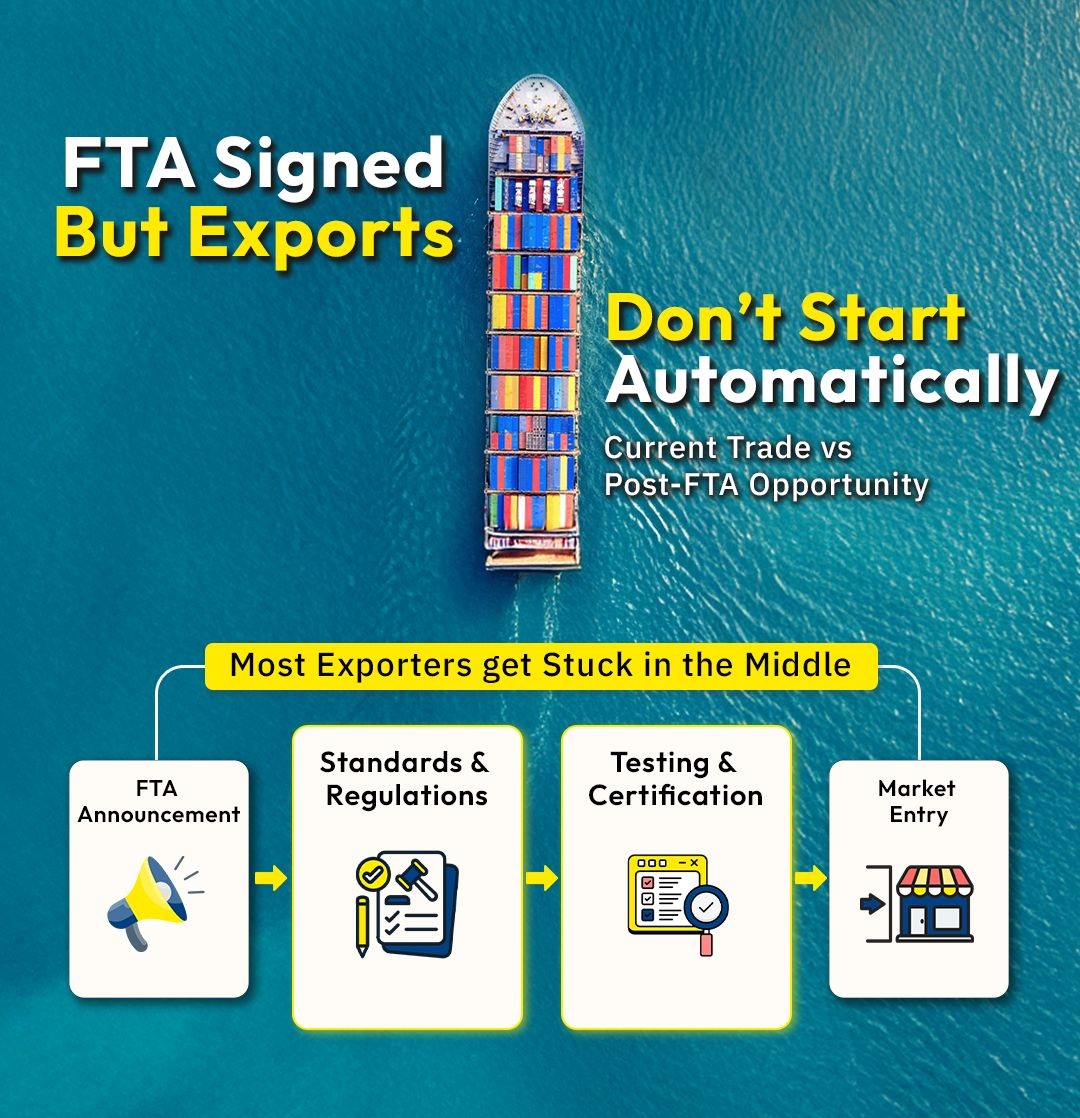
Most exporters believe global expansion fails because markets are difficult to enter.That’s...
In today’s rapidly evolving global trade landscape, new FTA agreements are being...
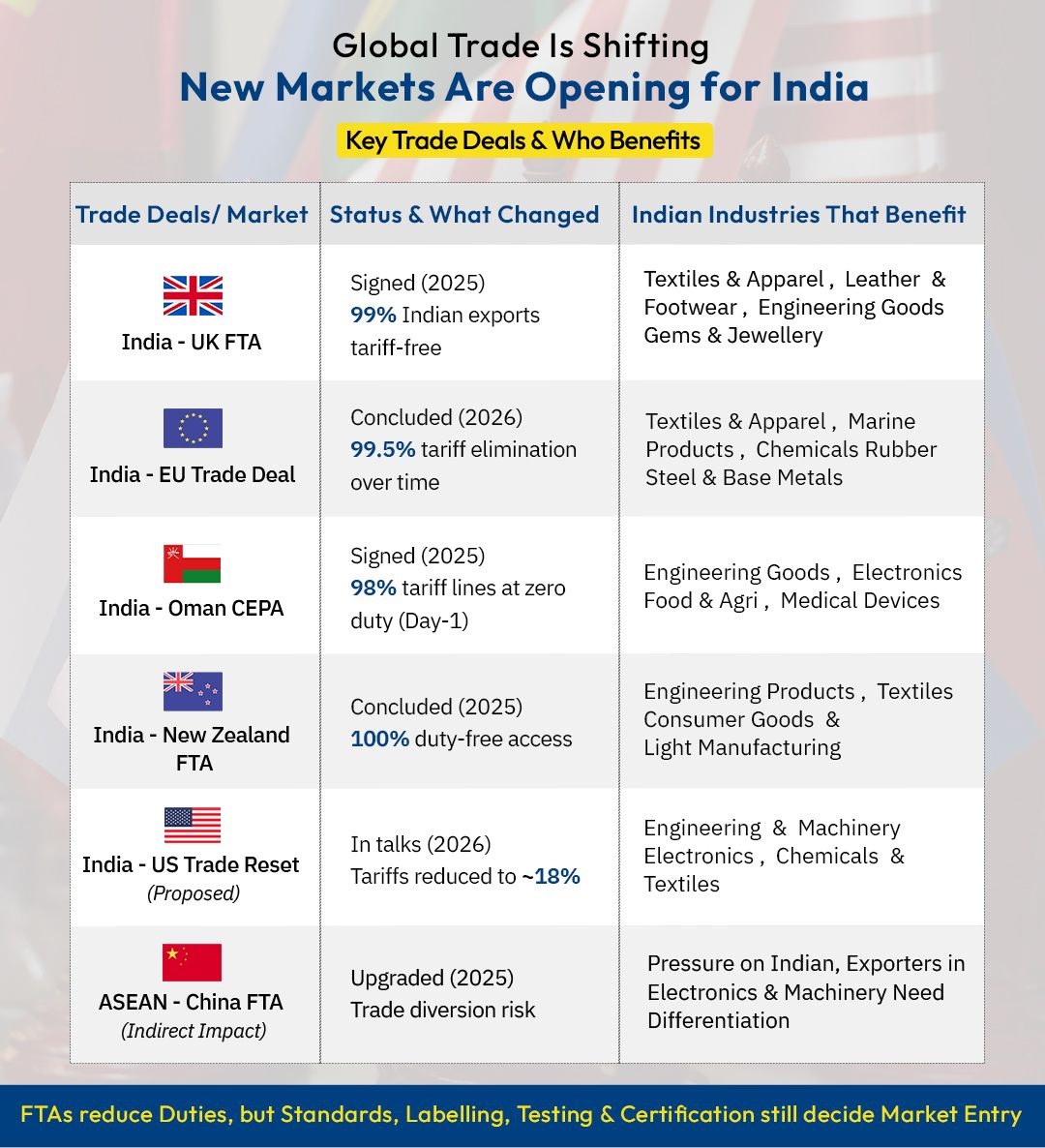
Tariffs Are Falling—But 90% of Indian Exporters Still Can’t Enter Global Market...

Trade policy sounds boring until it shows up in real life. Until...

Introduction A sort of conformity assessment known as CB certification verifies that...

How would you go about requesting an SASO Certificate of Conformity? If...

Overview of the Saber Certificate Companies registered in the Kingdom of Saudi...

Introduction International commerce is vital to the economies of many countries in...

How much does the Saber Certificate cost Recognizing the Saber Certificate Cost...