
AIR Required
You Cannot Apply Alone
Global Market Access India
End-to-end support for foreign manufacturers and brands entering India — BIS certification (CRS and FMCS/ISI), CDSCO, telecom approvals and EPR, managed by one Indian partner. India requires an Authorized Indian Representative on the ground, so the work needs someone here — which is exactly where we sit.
You Cannot Apply Alone
CRS · FMCS · Scheme-X
Gurugram-Based, India-Wide
At a Glance
The Bureau of Indian Standards (BIS) is one of the main authorities responsible for product certification in India. For many regulated products, a requirement is initiated by a Quality Control Order (QCO) issued by the appropriate Government ministry or department. A QCO makes it mandatory for products covered by a specific Indian Standard (IS).
The two most common BIS routes for domestic and foreign manufacturers are Scheme I and Scheme II. Scheme I is associated with the ISI Mark. Foreign manufacturers obtain a license under the Foreign Manufacturers Certification Scheme (FMCS). This scheme generally includes product testing and inspection of the overseas factory. Scheme II is the Compulsory Registration Scheme (CRS), which applies to notified electronic and IT products and includes testing and registration of the product with BIS.
BIS is only one part of India’s regulatory system. Additional approvals may also be required depending on the product, such as WPC for wireless products, TEC-MTCTE for telecom equipment, BEE for energy-efficient appliances, and EPR for electronics, batteries and plastic packaging.
Overview
In India, several products are regulated by Quality Control Orders (QCOs). Once a requirement is implemented, the product must obtain the relevant certification before it can be manufactured, imported or sold in India.
Scheme I is the ISI Mark certification route for domestic manufacturers. Manufacturers with factories outside India can obtain a licence under the Foreign Manufacturers Certification Scheme (FMCS). The process involves product testing and inspection of the overseas factory.
CRS mainly covers electronics and IT products. The product is tested against the relevant Indian Standard (IS) and registered with BIS before it is placed on the Indian market. CRS registration does not include a routine factory inspection.
BIS is only one pillar of India’s regulatory structure. Depending on the product, you may also need WPC ETA for wireless products, TEC-MTCTE for telecom equipment, BEE for energy-efficient appliances and EPR for applicable electronics, batteries and plastic packaging.
Who Needs It
By Industry
India has different approval pathways for different types of products, so it’s important to choose the right one from the beginning. The table shows common categories. As a general rule, MeitY-notified electronics follow CRS, other QCO products may follow FMCS/ISI, and products with radio or telecom functions may also need WPC or TEC approval.
| Industry / Product Category | Primary Route | Authority | Also May Need |
|---|---|---|---|
| Electronics & IT Goods (mobiles, laptops, LED products, power banks, TVs) | BIS CRS (Scheme II) | BIS | WPC ETA if wireless |
| Household & Commercial Appliances (QCO 2026, 90+ categories) | BIS FMCS / ISI (Scheme I) | BIS | BEE star label |
| Wireless & Telecom Equipment | WPC ETA + TEC-MTCTE | WPC & TEC | BIS CRS if also notified |
| Solar & Energy Products | BIS + BEE | BIS & BEE | — |
| Building & Construction Materials (steel, cement, fittings) | BIS FMCS / ISI | BIS | — |
| Toys | BIS ISI | BIS | — |
| Chemicals & Polymers | BIS FMCS / ISI | BIS | — |
| Packaging, Electronics & Batteries | EPR Registration | CPCB | BIS, if applicable |
Send us your product details and HS code, and we will map the correct route. Check my India requirement
Schemes
Covers electronics and IT products requiring BIS-recognised testing, registration and use of the Standard Mark with an allocated R-number.
Allows foreign manufacturers of ISI-covered products to obtain a BIS licence through product testing, overseas factory inspection and an Authorised Indian Representative (AIR).
WPC frequency approval and TEC-MTCTE certification depend on the product’s functions and classification, covering applicable wireless, RF and notified telecom equipment.
Includes energy-rated appliances and relevant solar products through BEE efficiency labelling and ALMM listing requirements for eligible solar projects in India.
Requires eligible producers, importers and brand owners to register with CPCB and meet ongoing recycling, collection and reporting obligations in India.
Process
Six steps to prepare a regulated product for the Indian market. The first two are especially important: choosing the wrong scheme or leaving representation unresolved can delay every step that follows.
Start here
Map the Quality Control Order (QCO) that covers the product, identify the exact Indian Standard (IS), and select the applicable route, such as BIS CRS, FMCS/ISI or another approval scheme.
India representation
Where the chosen scheme requires one, appoint Markek as your Authorised Indian Representative (AIR) and India-based point of contact for the authority, application and ongoing obligations.
Technical evidence
Arrange product testing with a BIS-recognised and appropriately accredited laboratory for the relevant category and standard. Match the laboratory’s scope before sending samples; a report from an unsuitable lab may not be accepted.
Assessment
Submit the application through the applicable BIS process. For FMCS, BIS inspects the overseas factory. CRS does not require a routine factory audit.
Approval
BIS grants the CRS registration with an allocated R-number or the FMCS/ISI licence, as applicable. The relevant Standard Mark or ISI Mark can then be used on the approved product and packaging in accordance with the scheme.
Ongoing compliance
Maintain product conformity, respond to applicable BIS surveillance, and renew the registration or licence when due. Markek supports the AIR obligations throughout the approval period.
Documentation
Factory-audit readiness and quality-management documentation.
RF test reports and technical parameters. CE or FCC reports may support the file where the applicable route accepts them.
Producer or importer registration details and packaging or product data for CPCB.
Timeline & validity
Around 3–4 weeks
Indicative time after acceptable testing and a complete application. Routine factory inspection is not part of CRS. Actual timing depends on BIS review and any queries.
Generally about 6 months
BIS gives this average from recording a complete FMCS application. Overseas factory inspection and product testing are part of the process, so individual projects may vary.
Other approvals: WPC ETA, TEC-MTCTE and EPR follow their own review processes. Confirm timing for the exact product and application route before setting a launch date.
Under BIS’s May 2026 revised provisions, CRS registration has a five-year validity, with annual fee and production-statement obligations. Plan renewal before the registration expires.
BIS initially grants the licence for one to two years, with renewal available for up to five years, subject to the scheme’s continued requirements and surveillance.
Do not let approval lapse. Once a registration or licence expires, continued use of its BIS Standard Mark or a claim of valid approval can breach BIS requirements.
Your India-based regulatory contact
A foreign manufacturer applying under FMCS must nominate an eligible Indian-resident Authorized Indian Representative (AIR). The manufacturer remains the applicant and licence holder; the AIR is its appointed contact and compliance representative in India.
Choose the AIR early and keep the appointment current. Markek’s Gurugram-based team coordinates the eligible AIR appointment and the certification work through one India-based point of contact.
Regulatory updates
Two changes affect how foreign manufacturers apply for BIS certification and which electrical appliances need it. Check the applicable scheme and current product scope before testing or shipment.
| Date | Change | Who it affects |
|---|---|---|
| FMCS applications moved online. BIS accepts new Foreign Manufacturers Certification Scheme applications through Manakonline; offline or hard-copy applications were accepted only through 31 May 2026. | Foreign manufacturers applying for a new FMCS licence. | |
| The 2026 electrical-appliances QCO took effect for general applicants. Covered household, commercial and similar appliances require the BIS Standard Mark under Scheme I to IS 302 (Part 1):2024. Separate dates apply to eligible small and micro enterprises. | Manufacturers and importers of covered electrical appliances, including commercial and industrial-use products within the order’s scope. | |
| Ongoing | Product-specific QCOs continue to change. Check the current BIS list, exact Indian Standard and whether a separate QCO already covers the product. | Any manufacturer introducing a new product, model or variant in India. |
Official references: BIS FMCS application guidance · BIS QCO implementation list · 2026 appliance QCO · Government summary of illustrative appliance list.
Cost
The total depends on the approval route, product scope and manufacturing locations. It can include authority fees, testing, overseas factory assessment where required, and AIR and coordination support. These are the main cost drivers.
| Cost driver | Effect on the project |
|---|---|
| Certification scheme | CRS, FMCS/ISI, Scheme X and specialist approvals have different fees and assessment steps. FMCS includes an overseas factory visit; routine factory inspection is not part of CRS. |
| Products, brands and factories | Scope affects application and testing work. FMCS requires a separate application for each product or Indian Standard and factory location. CRS registration is tied to a manufacturing location; brand and model coverage must be checked against its rules. |
| Laboratory testing | Testing must follow the applicable scheme and use an accepted laboratory with the right standard in scope. Existing reports may support review, but they do not automatically replace required BIS testing. |
| Factory assessment | Where required, inspection days, overseas travel and any corrective-action work add to the cost. This is often a major FMCS variable. |
| Additional approvals | A product may need WPC, TEC-MTCTE, BEE or EPR work alongside BIS certification, depending on its functions and category. |
| AIR and ongoing compliance | An eligible Authorized Indian Representative may be required for a foreign applicant. Budget for the applicable representative, surveillance and renewal obligations throughout the approval period. |
Common mistakes
CRS and FMCS/ISI have different product scopes and application steps. Starting the wrong route can mean repeating work.
Fix: Match the product and applicable QCO to the correct BIS scheme before testing.
The 2026 appliances QCO excludes products already covered by another QCO or mandatory BIS certification requirement. A notified CRS product should not be routed through that appliances QCO as well.
Fix: Check the exact product listing and exclusion before opening another BIS application.
A report from a lab without BIS acceptance for the relevant Indian Standard may be unusable for the application.
Fix: Check the lab’s current BIS recognition and exact testing scope before sending samples.
A foreign FMCS applicant must nominate an eligible Indian-resident Authorized Indian Representative who can meet the licence’s ongoing responsibilities.
Fix: Appoint a qualified, responsive AIR when preparing the FMCS application.
Product-specific QCOs and their effective dates change. A category that was previously unregulated may now require BIS approval.
Fix: Recheck the current product scope and implementation date before import.
BIS certification does not by itself address radio equipment approval or a notified telecom-equipment requirement.
Fix: Screen radio features for WPC ETA and the product category for TEC-MTCTE.
Plastic packaging, electrical and electronic equipment, and batteries can create separate producer, importer or brand-owner duties under their applicable waste rules.
Fix: Check the entity’s EPR role and registration route alongside product certification.
Continuing to use or claim a BIS Standard Mark without a valid licence or registration can breach the BIS Act and interrupt sales.
Fix: Track the actual expiry date and start renewal before the approval lapses.
Similar products can map to different standards, and the test report must match the requirement in the applicable order.
Fix: Confirm the exact IS number and edition during classification.
Markek support
Markek International Certifications is based in Gurugram, India, and is NABCB-accredited for defined product-certification and inspection scopes under ISO/IEC 17065 and ISO/IEC 17020. Our India-based team helps foreign manufacturers coordinate the right approval route with one accountable local point of contact.
Where required and eligible, an India-resident representative from our team can be formally nominated as your AIR. The named AIR is the BIS contact and supports compliance responsibilities throughout the licence term.
Before you spend on testing, we check the applicable Quality Control Order, identify the exact Indian Standard and determine whether the product follows CRS, FMCS/ISI, Scheme X or another route.
We help select a BIS-recognised laboratory with the relevant standard in scope, review the technical file and prepare your overseas factory for the BIS assessment required under FMCS.
Where applicable, we coordinate WPC and TEC approvals, BEE or ALMM requirements, and CPCB EPR registration alongside BIS work so the product follows a coherent market-entry plan.
Accreditation records: NABCB product certification · NABCB inspection. AIR requirements: BIS guidance.
Yes, BIS certification is mandatory if your product is covered under a Quality Control Order (QCO) and the product cannot be imported, sold, or distributed without BIS certification. Electronics and IT products are covered under the Compulsory Registration Scheme (CRS) and other QCO products are covered under the Foreign Manufacturers Certification Scheme (FMCS) and carry the ISI Mark. The QCO list is growing all the time, so the safest first step is to test for applicability.
CRS is for listed electronics and IT products, it includes lab testing but no factory audit and results in registration with an R-number. FMCS is for foreign manufacturers of other QCO products, it requires testing and a BIS factory audit at your overseas site, and results in an ISI Mark licence. They are not the same and applying under the wrong one wastes months of time so you have to make sure of the scheme first.
Yes, if you are a foreign manufacturer. A foreign manufacturer does not have direct interaction with BIS, instead, it has to appoint an AIR, which is a legally accountable presence in India, which is the point of contact with BIS, manages the portal and carries regulatory responsibility. In 2026, BIS has increased monitoring of the AIR’s role, so selecting an experienced, accountable AIR is a real compliance decision. Markek acts as AIR for its clients.
CRS is usually about 3-5 weeks after testing, no factory audit required. FMCS takes longer, often several weeks to a few months, because it also includes a factory audit at your overseas facility. That’s why you should get FMCS started long before you plan to go to market. Telecom and EPR routes are on their own time frames.
The registration on the CRS is valid for two years and needs to be renewed before expiry. An FMCS/ISI licence is issued for a set period of time and renewed under continued BIS oversight. Selling a product with an expired BIS registration/mark is an offence under the BIS Act, 2016. Hence, renewals should be planned well in advance of the expiry date.
Yes. For every device with a radio function, WPC Equipment Type Approval (ETA) is required and notified telecom equipment requires TEC certification under MTCTE, which is separate from BIS. The product also requires CRS if it is on the CRS list. Internationally recognised CE/FCC reports usually serve as supporting proof for wireless approvals.
Extended Producer Responsibility covers producers, importers and brand owners of plastic packaging, electronic goods and batteries. You have to register for EPR with the Central Pollution Control Board (CPCB) and meet the collection and recycling targets. It’s a separate requirement from product certification and often catches importers out, so it should be considered alongside your BIS work.
Two things to note. FMCS is fully digital as of 1 June 2026, no paper applications are accepted and everything is via the Manak online portal. An appliances QCO will make BIS/ISI certification mandatory for over 90 categories of household, commercial and industrial electrical appliances from October 1, 2026, bringing in many companies that never considered themselves appliance makers.
They are either detained or refused by customs, and foreign factories that ship regulated products without BIS certification often face 30 to 60 days of shipment detention, warehousing costs and possible refusal. Certification and AIR appointment take time, so they need to be done before shipment, an uncertified product cannot be regularized quickly at the port.
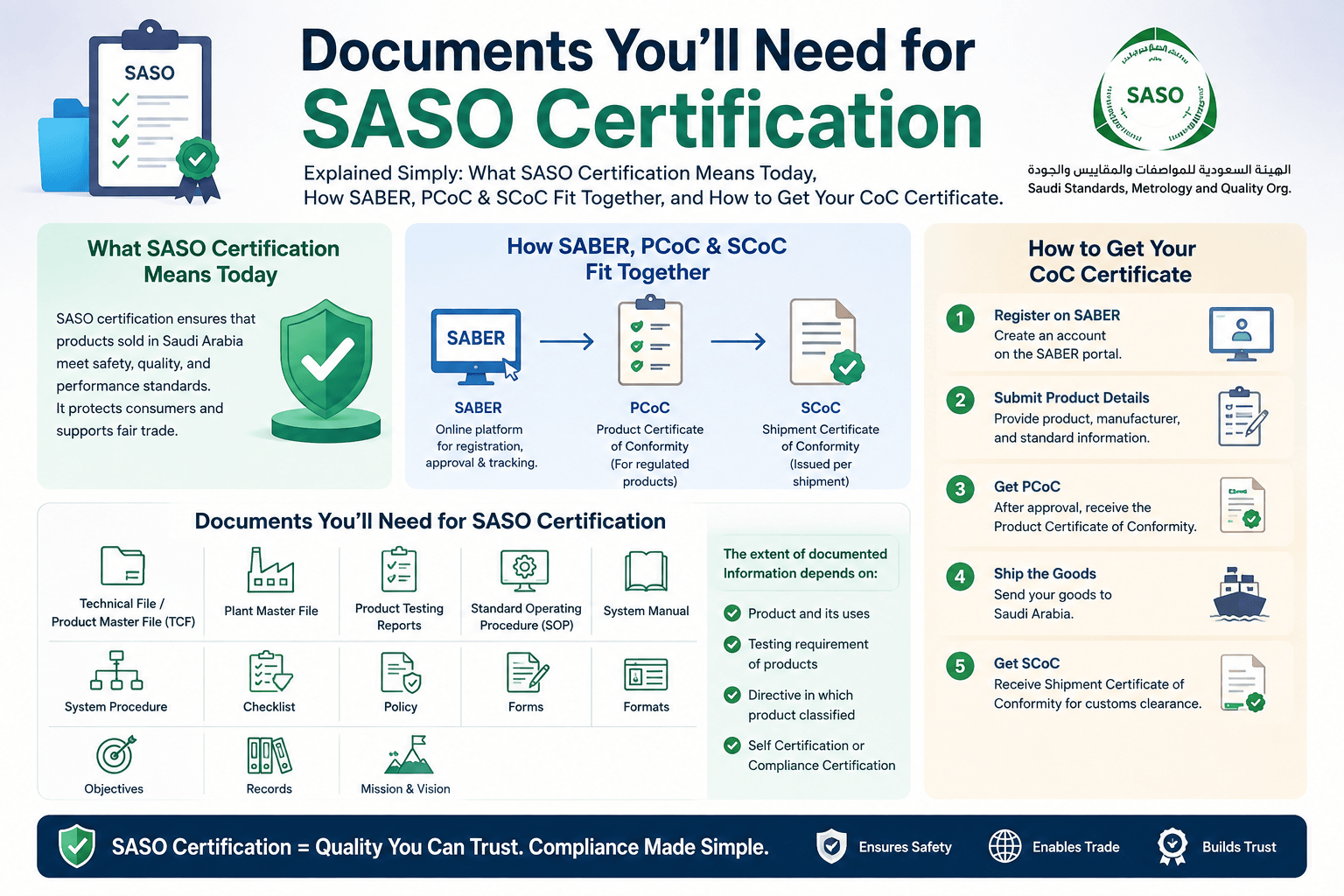
Most people who search for "certification SASO" have already lost time. A...

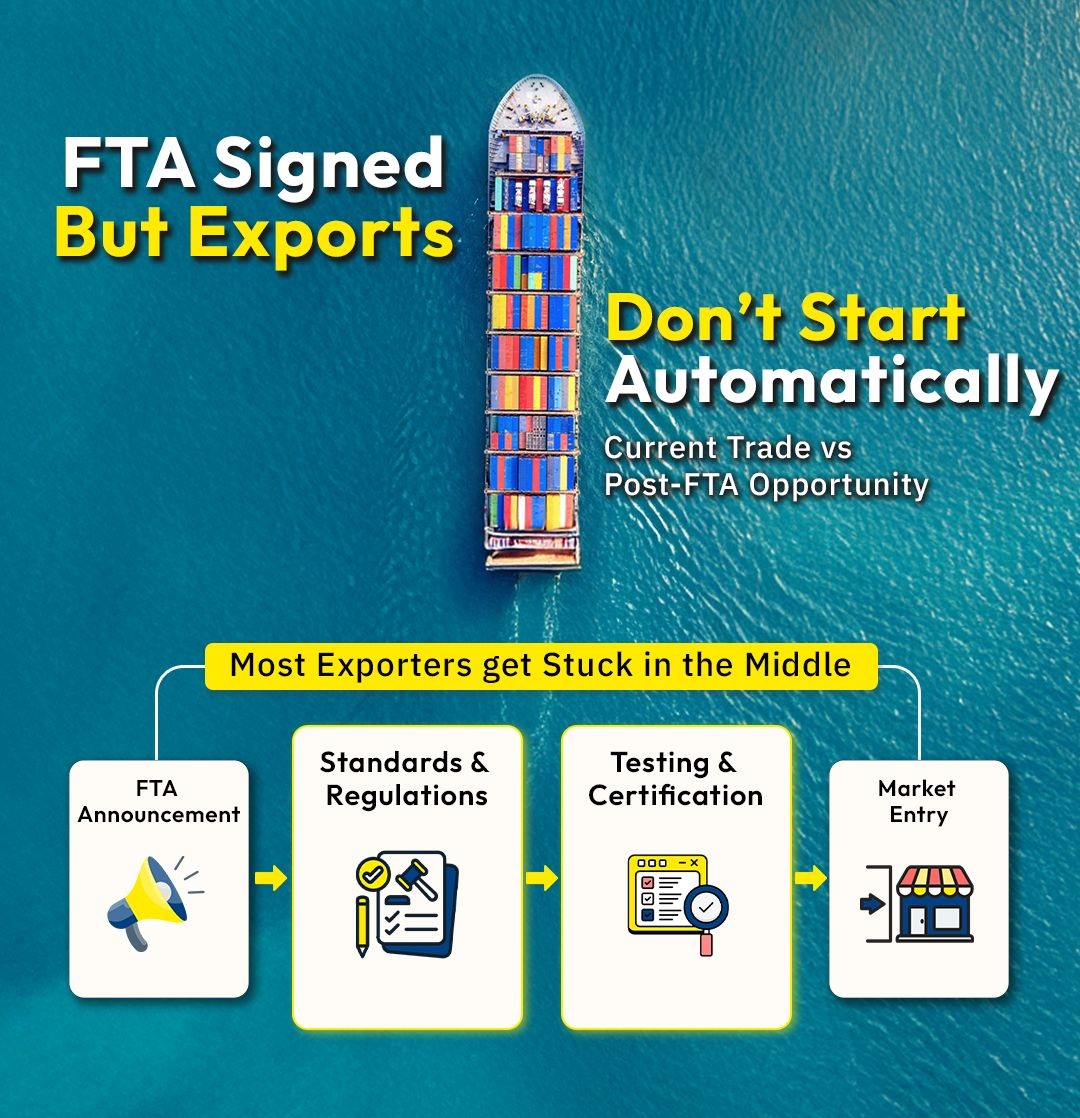
Most exporters believe global expansion fails because markets are difficult to enter.That’s...
In today’s rapidly evolving global trade landscape, new FTA agreements are being...
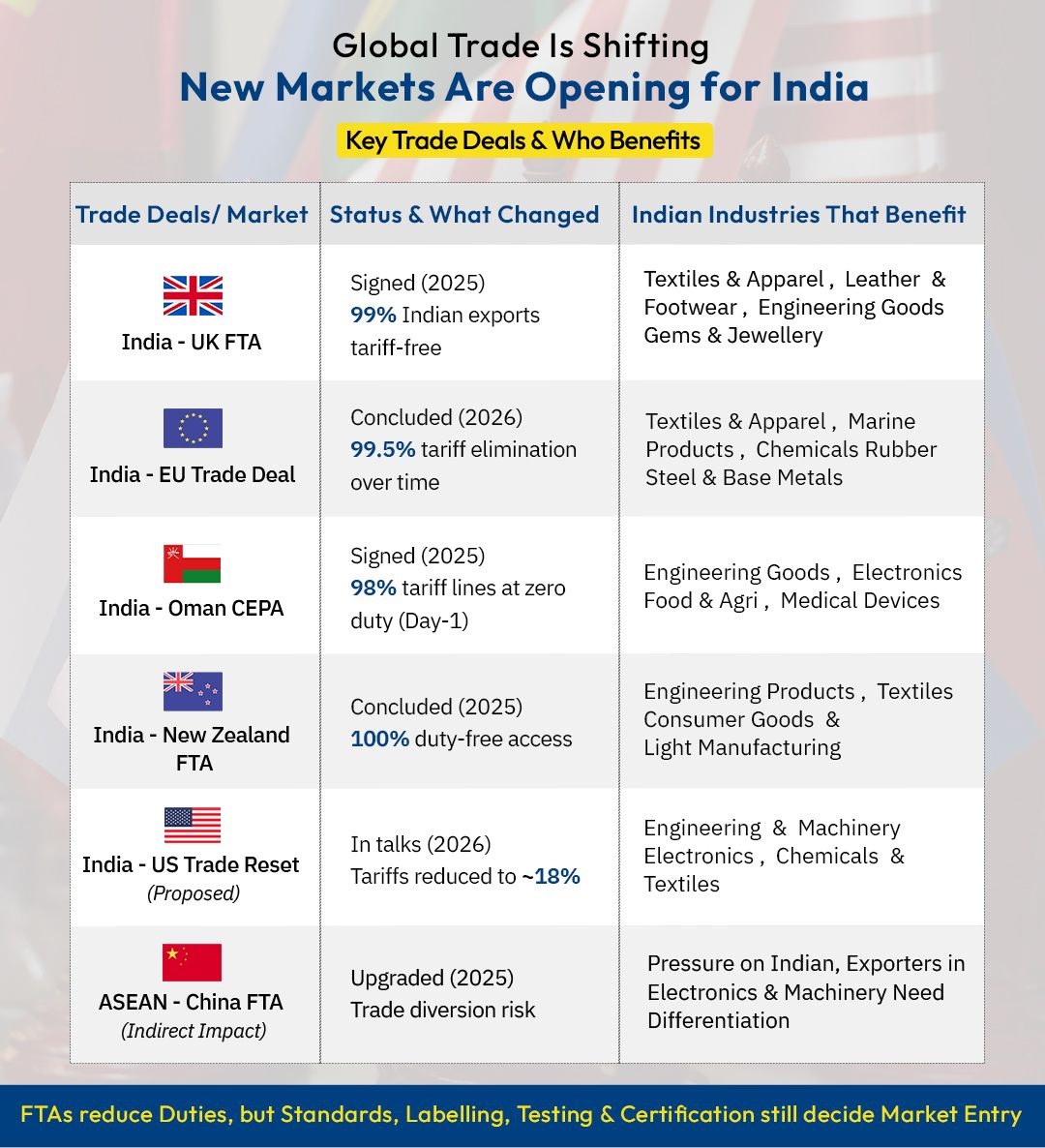
Tariffs Are Falling—But 90% of Indian Exporters Still Can’t Enter Global Market...
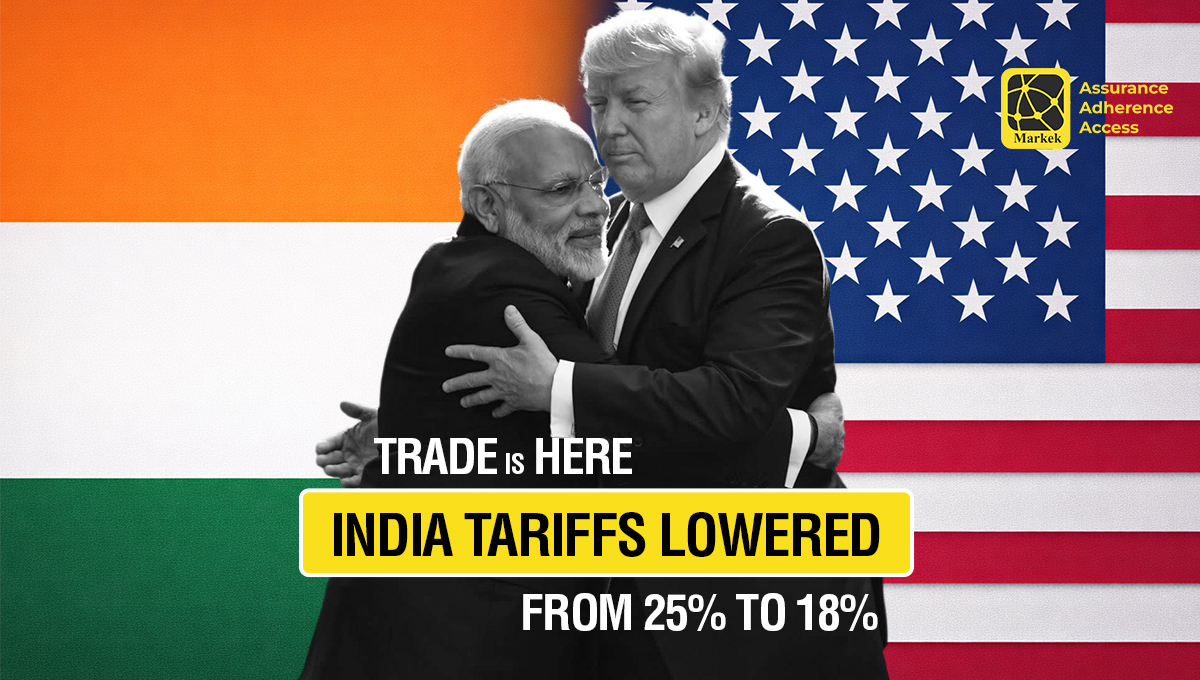
Trade policy sounds boring until it shows up in real life. Until...

Introduction A sort of conformity assessment known as CB certification verifies that...

How would you go about requesting an SASO Certificate of Conformity? If...

Overview of the Saber Certificate Companies registered in the Kingdom of Saudi...

Introduction International commerce is vital to the economies of many countries in...

How much does the Saber Certificate cost Recognizing the Saber Certificate Cost...